









By Clint Thompson
The first half of Eric Hunter’s life did not include agriculture. He had never been exposed to it. But after the last 25-plus years as a strawberry grower, he can’t imagine his life without it.
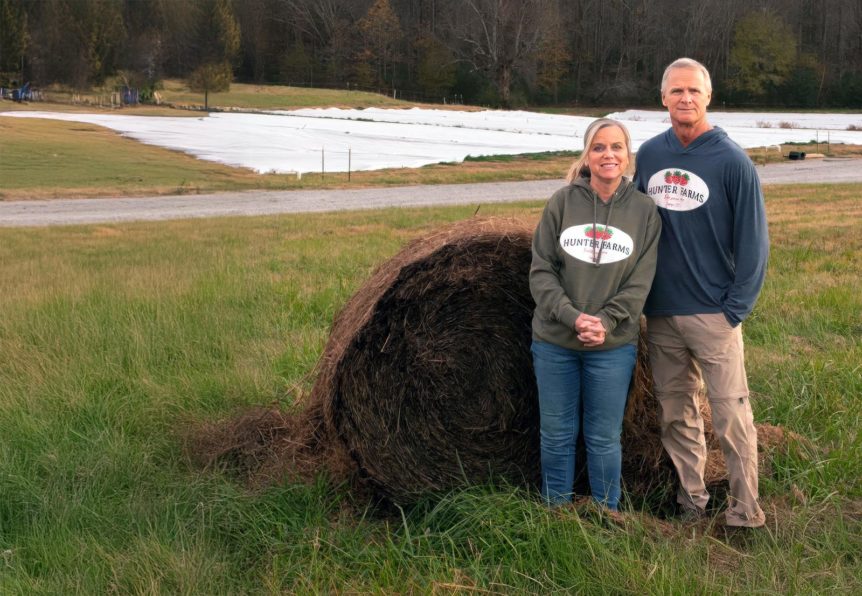
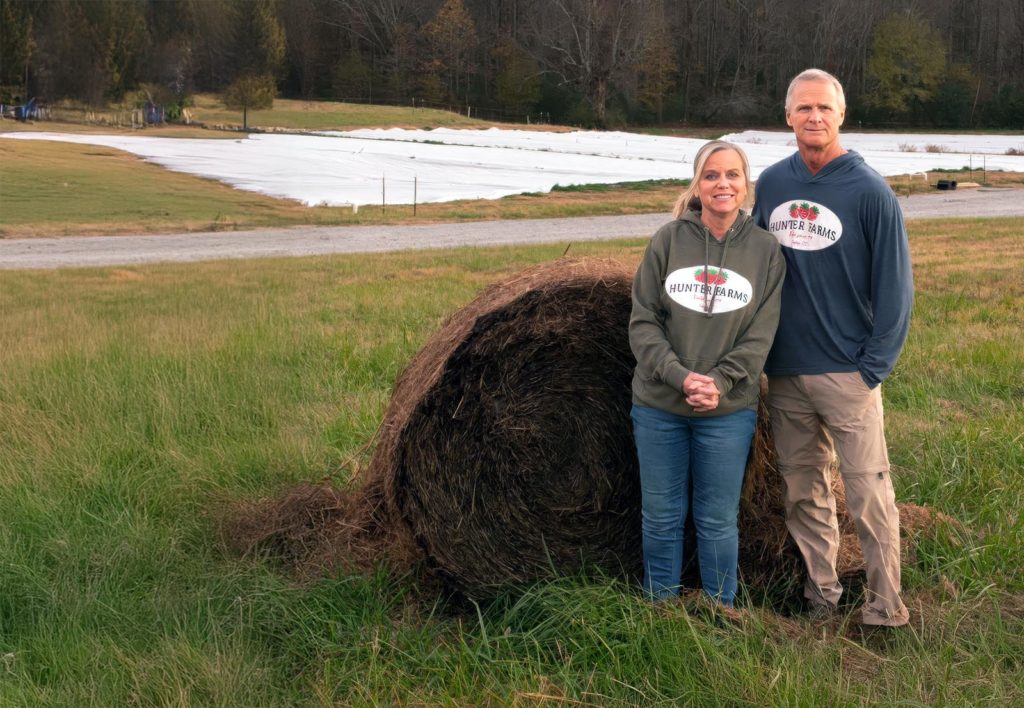
The South Carolina farmer views his agricultural career as a calling. He and his wife, Kristi, operate Hunter Farms, a small family farm in Easley. They grow approximately 5 acres every year, along with plug plants for other producers, while running an agritourism business in the fall and spring.
“We’re the epitome of a small family farm. We’ve got our core workers that have always been with us, but me, my wife and son pretty much handle everything,” Hunter says. “With the plugs, we grow them, load them and deliver them, so we do everything.”

Photo courtesy of Hunter Farms.
A Seed Is Planted
Before 1998, Hunter had never grown a garden, much less a successful and sustainable strawberry crop. But he recalls an important meeting he had that changed the course of his life.
“In the job I had, I traveled across the Southeast, and I saw strawberry farms here and there. There was a town about an hour from where I lived, and some Mennonites had a strawberry farm there,” Hunter says. “I stopped and talked to them one day and just decided that was something I thought I could do.”
The initial discussion planted a seed in Hunter’s mind. But only after extensive research did that seed blossom into a fruitful career.
“I got in touch with NC State University. I educated myself for about a year and jumped into it, not knowing anything about what I was doing. It turned into a career for me,” Hunter says. “I like being outside, and I hated working for people. When I was researching, there was nobody in our area growing strawberries. So, I just thought this might be an opportunity. From day one, we’ve done pretty well.”
The career change did not come without sacrifice. Strawberry farming required startup costs, including purchasing equipment. Hunter and his wife sold their personal vehicles to help cover the added expenses. Hunter also had to believe there was a market for the goods he would eventually sell.
Success From The Start
“It was a week before strawberry season when we were out walking through the field, which was only 1.5 acres. But there was a lot of strawberries,” Hunter says. “My wife said, ‘I don’t know if we’re going to sell all these strawberries or not.’ I said, ‘I’ll tell you what the Mennonite told me: The easiest part is selling them. If you can grow them, you’ll sell them.’ Sure enough, that first morning, cars were lined up. It’s been like that ever since.”
Hunter Farms succeeded from the start. The 1.5 acres ballooned quickly before Hunter realized that dialing back some of his farming operation was in his best interest.
“We got up to about 8 acres at one point, and after that it started trailing off. We’re down to about 4 or 5 acres right now, and that’s a good point for us,” Hunter says. “We do a lot of u-pick. A lot of families in the area come here every year. Probably 80% of the business is u-pick and buying straight from the farm. We do some wholesaling to small mom-and-pop type of stores, produce stands and that kind of thing.”
Diversification Is Key
Diversification has been an integral part of Hunter Farms’ success. The business expanded beyond its initial strawberry production. It started growing plug plants for other farmers in 2005, producing more than a million plugs at one point. Hunter grows plugs for farmers across the Southeast, including Florida, Georgia and South Carolina, and even some as far west as Oklahoma.
Agritourism is also a major component of the business. Hunter Farms offers a corn maze and a pumpkin crop, along with other tourism attractions during prime seasons.
“Having enough land is what helped us; being able to offer a lot of options for the people to come out and entertain their kids with. From food to games to hayrides, you need a lot of activities,” Hunter says. “You find something that somebody else isn’t doing and diversify from that. It makes a big difference.
“If you’ve got all of your berries in one basket and then something like a hailstorm happens, it will hurt you. Agritainment is something good to get into. It’s growing tremendously in the area where we are in South Carolina. That has helped a lot.”
Not Without Challenges
Like other farming operations, Hunter Farms has encountered its share of challenges through the years. Whether it was COVID in 2020 or the rise of Neopestalotiopsis disease in Southeast strawberries, especially last year, Hunter Farms has had to overcome multiple obstacles.
Neopestalotiopsis has been a danger to strawberry plants every year since it was first discovered during the 2018–19 season on five farms in Florida. The disease’s initial discovery was attributed to one nursery source in North Carolina. More than 20 farms experienced the disease during the 2019–20 season after it was attributed to two nursery sources early in the season in North Carolina and Canada.
The disease can lead to severe leaf spotting and blighting under favorable weather conditions, specifically during extended periods of wetness.
“It has really hit us hard the past two years. We’ve been dealing with it about three or four years. We really didn’t know until last year what we were dealing with,” Hunter says. “The ability to get clean plants has made the plug business really tough. We went the year before having more than a million plugs to maybe 200,000 last year. We had more come in, but they just all died.
“Neopestalotiopsis is front and center right now. It’s not going to go anywhere. We’re going to have to deal with this, probably from now on. The key is getting clean plants. If these plants have it and go into the field, it’s in the field and going to be there for a while.”
The spike in input costs following COVID has created a financial burden that farmers like Hunter have had to pass on to the consumer.
“Twenty years ago, before we even started the season, we may have $8,000 or $10,000 in an acre. Now, before we even pick a berry, we’ve probably got $22,000 in an acre,” Hunter says. “Every year it keeps getting higher, whether it’s the plants, the plastic or the chemicals. On the consumer end of it, we raise our prices to what we can, but there’s a limit on that. As far as cost efficiency, I am concerned with that going into the future.”
Video
Click here to watch a video and learn more about Hunter Farms.