









By Clint Thompson
Current drought conditions in Florida are not surprising. After all, the driest part of the season is typically during the months of April and May. But conditions are dire even for this time of year, explains Gene McAvoy, a crop consultant in South Florida.
It has been some time since he has experienced drought conditions of this magnitude.
“We haven’t had a drought like this in 20 years, at least. We didn’t have much of a rainy season,” McAvoy said. “Some of our growers, especially in the Southeast and south of Lake Okeechobee, they depend on the lake for water, and the lake is really, really low. We’re afraid that any day they might cut off irrigation.
“When it gets to a certain depth, they’ve got to stop irrigation out of the lake to save water for drinking water. Twenty years ago they did that. People just had to say, ‘If I’ve got 100 acres of citrus and 50 acres of corn, the corn’s got to go because I’m going to try and can keep this perennial crop alive.’”
Drought’s Impact
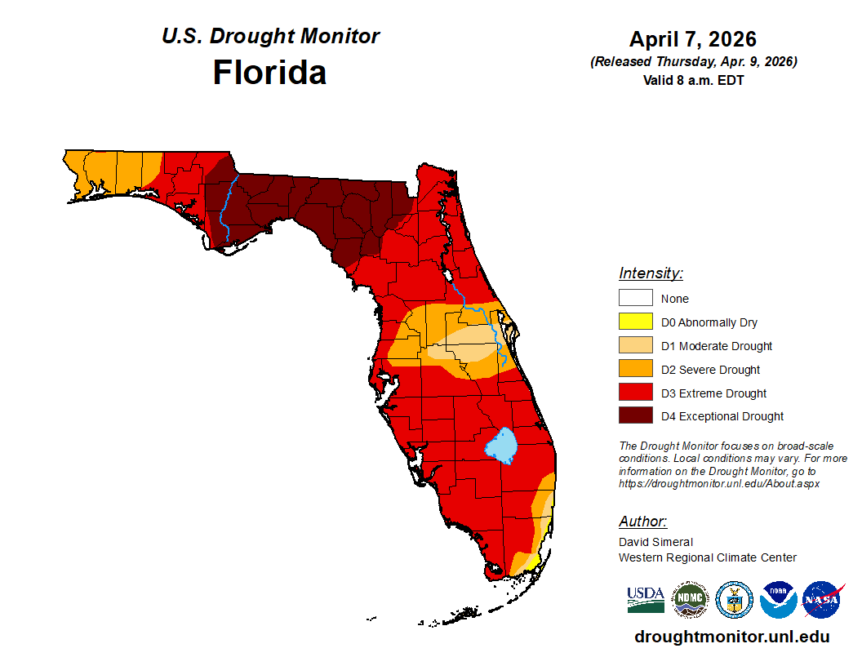
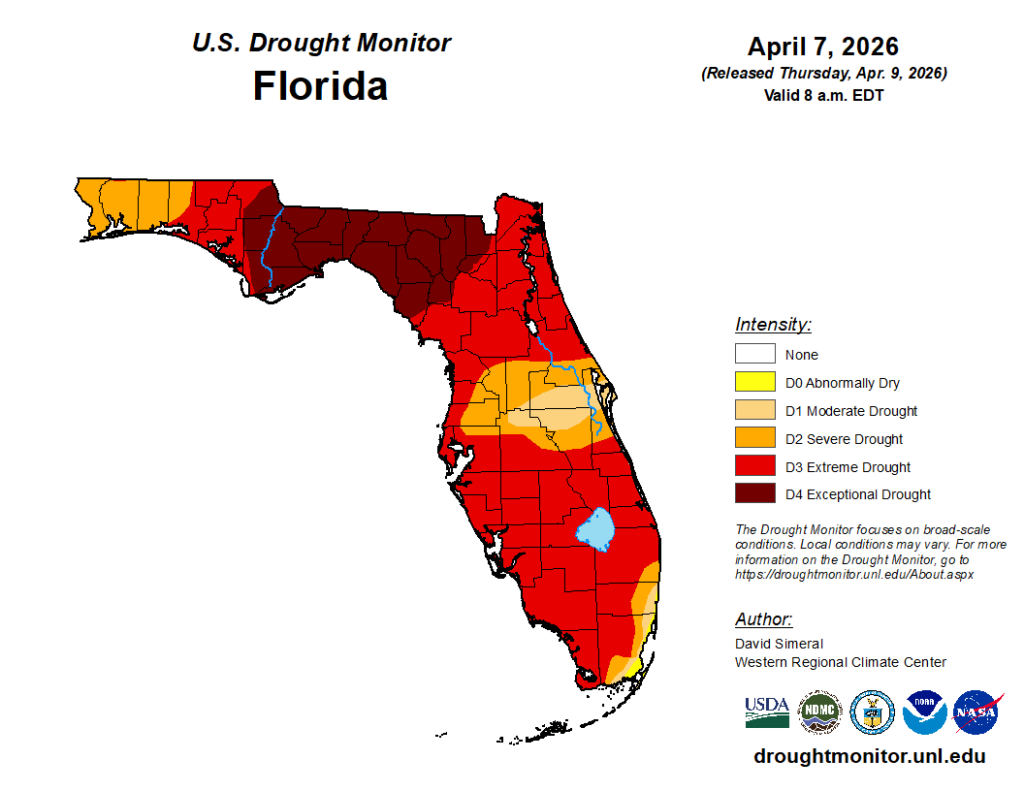
According to the U.S. Drought Monitor, extreme drought conditions cover most of South Florida, stretching from Hillsborough, Polk, Osceola and Brevard counties southward to Monroe and Miami-Dade counties. Exceptional drought conditions cover most of North Florida, stretching from Jackson, Calhoun and Gulf counties eastward to Baker and Union counties.
McAvoy highlighted where the drought is having its biggest impact in the southern region of the state.
“It’s really impacting citrus. You do irrigate them, but you’re only irrigating a small percentage of your root zone. We’re seeing a lot of fruit drop on citrus,” McAvoy said. “For things like melons, it’s actually favorable because you get a sweeter melon when you’re sunny and dry.”