









Weekly Field Update
Clemson Extension agents provide updates in The South Carolina Grower this week about the status of various crops being produced throughout the state.
Statewide
Tom Bilbo, Extension Entomologist
- I’ve been seeing high numbers of diamondback moths (DBM) around the state lately, especially in collards or other brassica crops that were left unmanaged. Some growers have started using the newly registered Syngenta insecticide Incipio (isocycloseram). This product is highly effective and can potentially suppress diamondback moths for up to 5 to 6 weeks. I think this very long window of control is due to a combination of long insecticide residual and DBM’s habit of laying eggs on older leaves. In the latter weeks, you may start seeing cabbage loopers and other ‘secondary’ pests, so keep an eye out for these.
- While this extended efficacy is great for suppressing DBM now, it poses serious questions about the risks of resistance development. I will write up a more thorough discussion of this issue soon, after a number of DBM researchers and I discuss how to best incorporate Incipio into IPM programs and delay the development of resistance. In the meantime, I highly encourage all brassica growers to continue rotating insecticides with different modes of action and to strive to conserve the highly impactful natural enemies of DBM. Example: use Xentari/Agree, Proclaim, Radiant, Exirel, or Avaunt eVo. Do NOT use bifenthrin or other pyrethroids, as these will only make your problems worse.
Lowcountry
Zack Snipes
- We didn’t get the rain we were all hoping for. This week looks promising, but I’ve said that a lot this year.
- Tomatoes are getting close to harvest. I have received several questions about blossom end rot. Remember, blossom end rot is a calcium deficiency, but 99.9% of the time, we have plenty of calcium in our soils. The deficiency occurs when the plant is not taking up enough water to transport calcium to the far ends of the rapidly developing fruit. Spraying calcium or putting eggshells in the plant hole will NOT help with this issue. Irrigating more frequently will help with this issue. For our sandy soils, growers should be running 3 to 4, 30 to 45-minute cycles per day during fruiting. Usually, blossom end rot is seen with the first fruit set and corrects itself on the second and subsequent fruit sets.
Pee Dee
Brad Fowler
- Once again, it has gotten pretty dry across the Pee Dee with only a few areas receiving any significant rainfall.
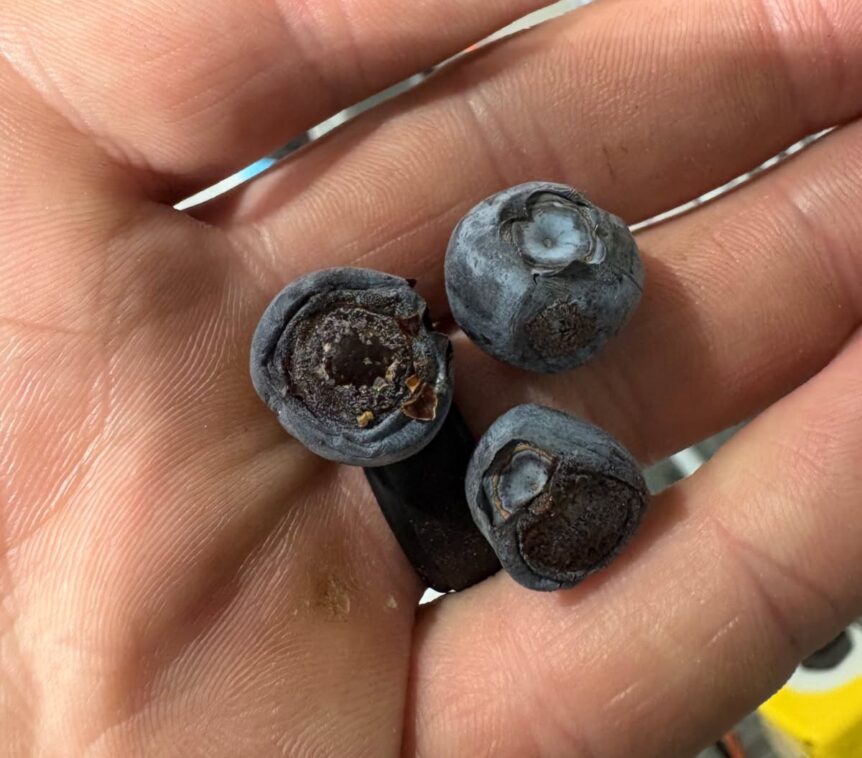
- Blueberries are still looking really good with no significant issues.
- Squash and zucchini crops are looking good, but be sure to stay on top of disease management, especially if we get rain.
- Keep an eye out for insect pests, such as striped cucumber beetles and for possible squash vine borer activity.
- Muscadines are also looking good with no real issues to report at the moment.
Upstate
Samantha Brown
- We wanted rain, and boy, did we get it. Heavy rainfall fell throughout the weekend, with some locations receiving 4-plus inches in a short time. Additional chances remain throughout the week, creating favorable conditions for disease activity.
- Due to excessive rainfall, standing water and saturated soils, root stress and root rot may occur. Working in wet fields can lead to overly compacted soil, so take that into consideration.
- As we know, warm, humid soil can lead to increased insect populations. Frequent scouting will help us determine when our thresholds are met.
- As the weather is warming up, peaches and blueberries are taking off. While the late frost had some effects, it looks as if we still will have a good season.
Andy Rollins
- Strawberry flowering and fruiting are slowing significantly, especially in short-day varieties like Fronteras and Ruby June, and even more so in Camarosa. If growers are interested in later production, we need to look at growing some long-day/day-neutral varieties. Rain in Upstate is increasing disease issues across the board.
- We are finding plum curculio in peaches. Growers need to rotate their insecticide groups and avoid relying solely on pyrethroids to control this pest. Some late-season varieties are gumming from cold damage in the seed. Many seeds are splitting longways, but the seeds themselves are still alive. At first, I believed these tiny gumming spots were from stink bugs, but that turned out not to be the case.
- Muscadine flower buds are beginning to open now. I recommend using Captan and Topsin M in the bloom stage, especially if growers are having rain during bloom.