









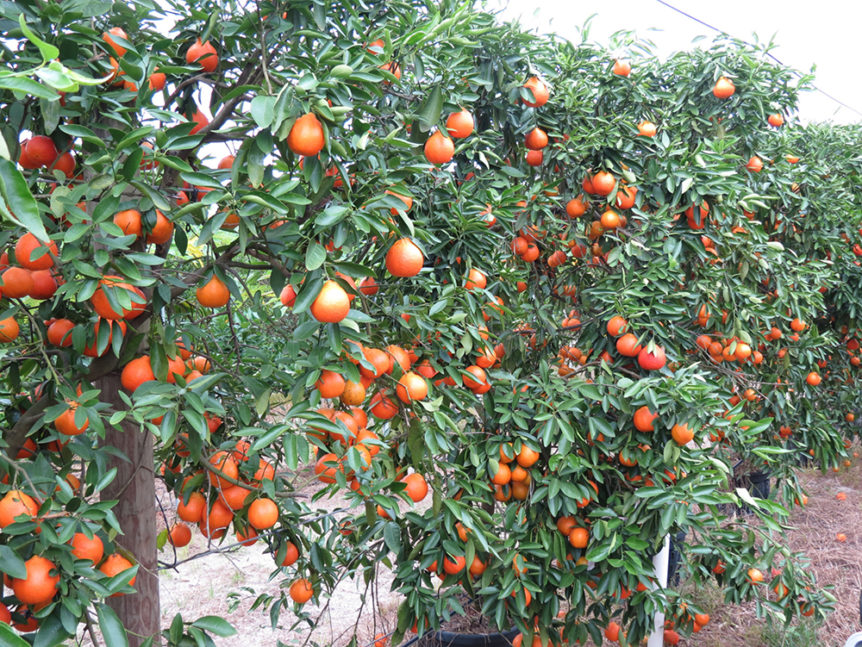

(Photo courtesy of UF/IFAS)
Citrus under protective screen (CUPS) provides citrus growers with a way to overcome the challenges of huanglongbing (HLB) disease. While grapefruit is the predominant variety grown in CUPS, research is underway to expand the varieties grown under screen.
That’s one of the remaining CUPS research hurdles for Arnold Schumann, professor of soil fertility and water quality at the University of Florida Institute of Food and Agricultural Sciences (UF/IFAS) Citrus Research and Education Center.
Schumann says the last important milestone to be reached in CUPS is figuring out how to grow a wide variety of citrus — including soft citrus and round oranges — in the system. “It is a different growing system in CUPS. It’s a different climate in there,” he said. “We did it for grapefruit. We know exactly how to grow grapefruit in there — including pest control, fertilizer, everything.
“The number one (objective) is getting more scope of what we can grow in there comfortably and reliably. We don’t know all the answers to that yet, but there are people actively working on it right now. I’m helping with that effort, too. It’s a multi-researcher effort to get more data on other varieties.”
Schumann estimated that about 2,000 acres of grapefruit are grown in Florida CUPS. He says grapefruit has produced well in the system, and now researchers are hoping to maximize the CUPS efficiency with other citrus varieties.
The research is focused on finding other varieties that can be grown in CUPS, but not necessarily at the same volume as grapefruit.
“If it’s a high-value variety that sells for more per box than grapefruit, you can make do with less and still make the same profit,” he explains.
Schumann cited the Minneola tangelo as a prime example. “It’s a very high-value gift fruit, and it does grow quite well in CUPS, but the yields are not as high as grapefruit. But because of its value, you get the same — or maybe better — profits and payback,” he said.

By Clint Thompson