









By Clint Thompson
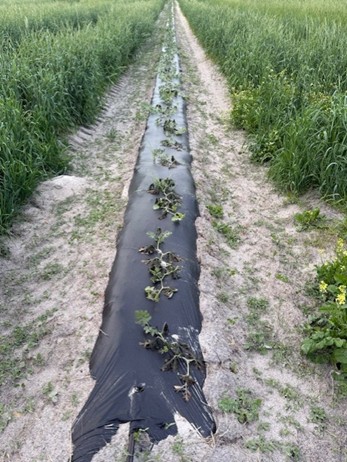
Cold temperatures last week had an adverse effect on recently-planted watermelon plants in North Florida’s Suwanee Valley Region. Growers are determining how to best help their young plants recover.
Bob Hochmuth, University of Florida Institute of Food and Agricultural Sciences (UF/IFAS) Regional Specialized Extension agent in Live Oak, Florida, provided advice for producers who are making chemical applications this week.
“I tend to be pretty conservative on spraying materials on top of the plants. It doesn’t necessarily make sense to me that with a plant that has just been fried from the cold and there’s no leaves to pick up anything to speak of – the only leaves are going to regrow from the base of the plant – when we start thinking we’re going to bring back those plants by spraying nutritional materials to the top, there’s no leaves to pick it up,” Hochmuth said.

“I think the part of the plant that is functioning and is ready to go and help would be the root system. The root system stays intact, and we’ve got this big root system that’s been developing for three or four weeks. If the crop needs something, let’s give it to the plant where we know it can pick it up and that’s through the root system.
“It makes more sense to me that if you’re going to do something like that, bring it through the root system and not through the top that’s been beaten and banged around.”
Cold Couple of Days
Hochmuth estimated that there was about 95% of the watermelon crop planted before the sub-freezing temperatures on Tuesday and Wednesday moved through the region last week.
“Both nights got colder than the forecast in certain areas,” Hochmuth said. “I think a lot of times we get a mixture from north to south in this region, and it doesn’t always pan out that the north was colder than the south. But in this particular case, it was that way. The coldest air was in the north and west of the region. The further south you went, the better the conditions were. I don’t know that anybody went out of it without being touched a little bit.
“We did have some situations where entire fields would have to be replanted but not very many of those.”