









www.jkase.com
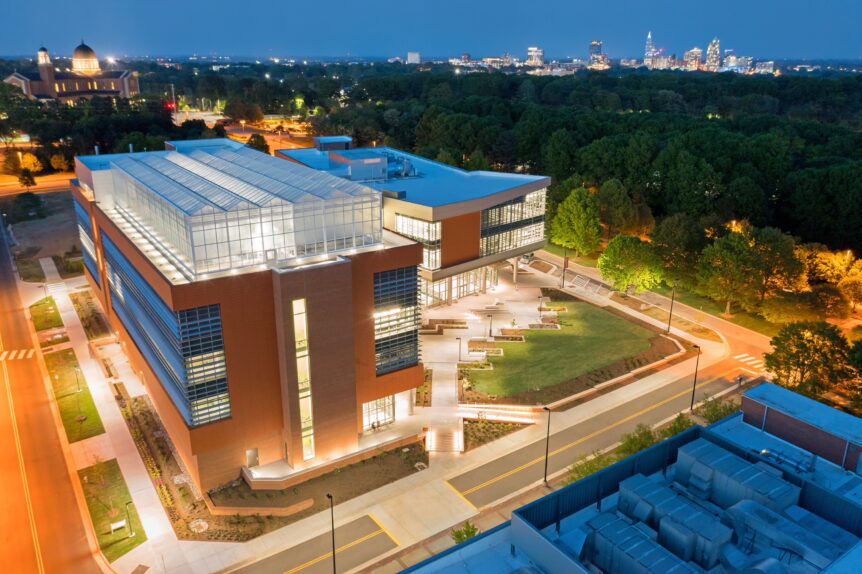
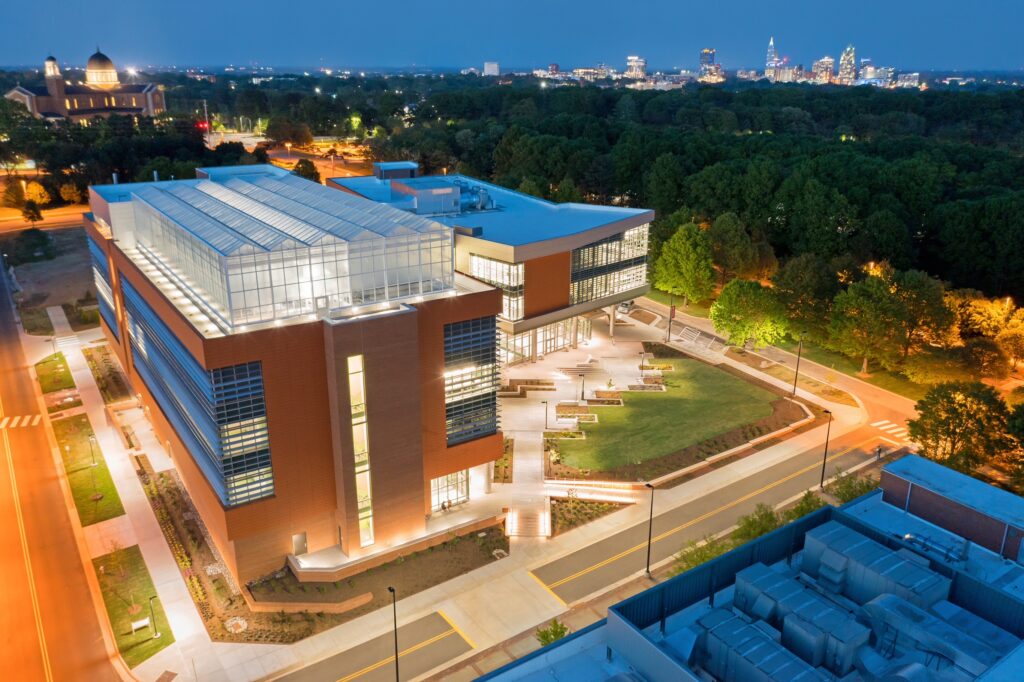
Credit: Justin Kase Conder/In 2022, the NC State Plant Sciences building opened on the university’s main campus in Raleigh.
Editor’s Note: This is an article in a series featuring land-grant universities and plans to prepare for technological advancements.
NC State University was founded in 1887 and has been a hub for agricultural learning and innovation over the years. As the ag-tech revolution kicks into high gear, NC State has two initiatives aimed at leading the way in plant genetics and artificial intelligence.
Plant Sciences Initiative
In 2022, the NC State Plant Sciences building opened on the university’s main campus in Raleigh. The building is home to a team of scientists who work in a variety of disciplines. It is also home base for the North Carolina Plant Sciences Initiative.
The initiative aims to tackle some of the biggest challenges in agriculture on the state, national and global level. Research is focused on increasing crop yields, creating new varieties, extending growing seasons, enhancing agricultural and environmental sustainability and producing new and improved technology.
One of the challenges in ag tech is collecting data and aggregating it in a way that is useable in real-word applications. An example of how NC State researchers are working to bring solutions to the table is the Ag Image Repository (AgIR). This collaboration between the university and U.S. Department of Agriculture is a growing collection of 1.5 million high-quality photographs of plants and associated data collected at different stages of growth.
How will these images be used? Alexander Allen, head of the AgIR’s system software development team, says that the repository is designed to help researchers who want to create AI-based solutions for farmers, plant breeders and others in agriculture. The images also are being used to teach new automated weeding machines what crops and weeds look like, so the machines know how to attack the weed and avoid the crop. That sounds simple, but it’s a complicated process that will be aided by this work.
“The lack of publicly available, high-quality agricultural images has been a barrier to advancing machine-learning research in agriculture,” Allen said. “Access to this data will be game changing for plant intelligence technology around the world, leading to an increase in design technologies for precision agriculture to help farmers get the most out of their fields while protecting their fields and nature from ecological damage.”
The development of high-tech tools is part of the initiative’s data-driven approach. The Makerspace is a lab and service center for rapid prototyping of low-cost custom hardware and software solutions for monitoring plant and crop systems across agricultural scales. It is fully equipped with state-of-the-art technology, tools and equipment to enable collaborations among researchers from different disciplines.
The lab provides tools to build technology onsite. This includes 3D printers, metal-cutting routers, robotic circuit assembly and more. One tool, the V-One PCB printer, prints circuit boards with different techniques. The turnaround time, from design to a fully assembled board, is reduced from a few weeks to a few hours with the technology. The lab is a tech geek’s dream come true.
Genome Editing Center
The Genome Editing Center for Sustainable Agriculture at NC State works to develop new gene-editing tools to speed up the process of bringing new crop varieties to growers. According to NC State’s Rodolphe Barrangou, CRISPR technology is one of those tools.
“CRISPR enables much faster breeding, Barrangou said. “In crossing and mating crops, plants and trees, the timelines are long — sometimes decades. We can do in the lab the same thing that would happen in nature, up to 10 times faster. And the scale at which we can do genetic breeding is five to 10 times broader and deeper.
“We know a lot about genetics, genomes and data, and we can use artificial intelligence and machine learning models to inform our breeding strategies. We can go into the genetic potential of any one crop and combine the best traits that exist into elite, commercially relevant germplasm. In tomatoes, we can take the best traits of heirloom tomatoes in terms of flavor and put those into tomatoes that have been bred to grow larger.”
Video Component
For video component, click here