









By Frank Giles
Editor’s Note: This is the fourth article in a series featuring land-grant universities and plans to prepare for technological advancements.
Clemson University has been a center for agricultural research since its founding in 1889. The school’s College of Agriculture, Forestry and Life Sciences and its Cooperative Extension Service actively conduct research and outreach to support farmers, agribusinesses and rural communities.
Increasingly for land-grant universities, this means positioning research and learning capabilities to adapt to the rapidly changing technology landscape. Artificial intelligence is driving innovation and disrupting economic sectors, including agriculture.
Center for Agricultural Technology
At the core of Clemson’s ag-tech studies is its Center for Agricultural Technology. According to Denise Attaway, an editor in Clemson’s Communications Department, the center is focused on research and education as well as collaboration with growers and industry to develop technology solutions aimed at improving farming operations.
Located at the Edisto Research and Education Center in Blackville, South Carolina, the Center for Agricultural Technology consists of communities designed to bring together public and private industries to provide valuable information in the form of technology, expertise or funding as designated by guiding participation agreements.
The first community established at the center is the Ecosystem of Agricultural Technology Sharing. It focuses on the development, testing, training and deployment of precision agriculture tools for farmer use in South Carolina and beyond.
Precision Ag Program
The Clemson Precision Ag Program is also headquartered at the Edisto Research and Education Center.
“Through this program, data, products and research are delivered to help growers of all sizes throughout the state of South Carolina and beyond,” Attaway said. “Scientists develop calculators and web apps designed to be simple to use. Each calculator or web app contains instructions for operation.”
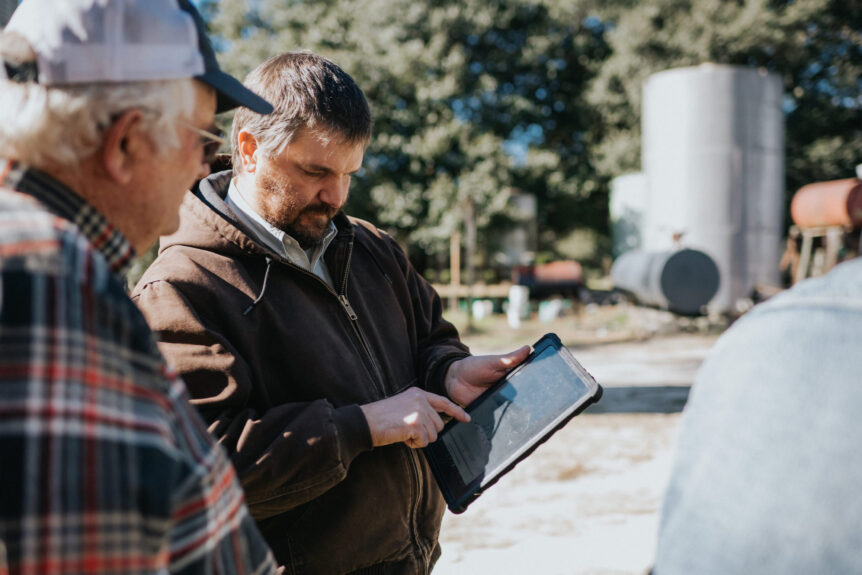
Nearly 20 calculator apps are available to help growers determine costs for various fertilizer applications and irrigation management. Visit is.gd/ClemsonCalculators to access all the calculators.
“Many of these tools were developed in collaboration with Extension team members and Clemson professors after South Carolina growers expressed concerns related to applying the proper amounts of inputs needed for their crops to grow,” said Kendall Kirk, director of the Clemson University Center for Agricultural Technology. “We realized we could make people’s lives easier by automating some of these calculations.”
Software Tools
The university has also developed software that is available to the public. An example is the Boundary Mapper program, which allows users to map field or other polygon boundaries by driving, walking or otherwise traversing the perimeter while obtaining GPS position from a receiver. The Center Pivot Mapper is a map-based tool for laying out new and existing pivot irrigation systems. There also is a Polygon Merge Tool that is useful with zones, grids, boundaries and more. Finally, the Soil Sampling Utility is a map-based interface for GPS collection of soil samples and other spatial point data.
Plant Breeding
Researchers at the Pee Dee Research and Education Center in Florence, South Carolina, are using new molecular breeding approaches (such as gene editing) to complement traditional breeding work. Current goals include enhancing crop nutrition, developing allergen-free crops, increasing genetic diversity in select crops and developing novel eco-friendly biopesticides.
“With the obtainability and sheer quantity of genomic data available, work is being done to develop tools and technologies that allow breeders to efficiently utilize their data to better guide their breeding programs,” Attaway said. “Christopher Saski, a systems geneticist and translational scientist in the Department of Plant and Environmental Sciences, is using his expertise in genomics, bioinformatics, computational biology, functional genomics and genome engineering to develop and deliver new ways to understand and exploit the crop genome and germplasm collections. The goal is to advance crop breeding, productivity, horticultural traits and resilience to abiotic/biotic stresses.”
Video Component
Click here to watch a video from Clemson University.