









By Frank Giles
When the weather cooperates in winter and spring, peach growers celebrate the good fortune. Chill hours and chill portions are a good way to measure that progress. But that’s not always an easy task with so many variables that can come into play. Dario Chavez, associate professor in peach and citrus breeding genetics and genomics with the University of Georgia (UGA), has helped growers navigate this process.
Regional Requirements
The amount of chill peaches receive is a good predictor of how well the crop will yield. According to Chavez, chill requirements can vary widely.
“If you consider Middle Georgia and South Carolina, you probably are looking at between 600 to 850 chill hours,” he says. “If you are in South Georgia or the Gulf region, you will be looking at 250 to 450 chill hours. In Florida, you could have cultivars from 50 (South Florida) to 200 (North Florida) chill hours.
“If you go to northern states, then you will probably not pay too much attention to the chill requirement as they get enough chill. We used to be able to grow 1,000-chill-hour cultivars in Middle Georgia. That is very difficult for us to do today. But in North Carolina, this is probably still okay.”
Available Options
Chavez says UGA provides tools to help growers measure chill. The tools can help calculate two chill models: the Weinberger Model (number of hours below 45 degrees) and the Modified Weinberger Model (number of hours between 32 and 45 degrees).
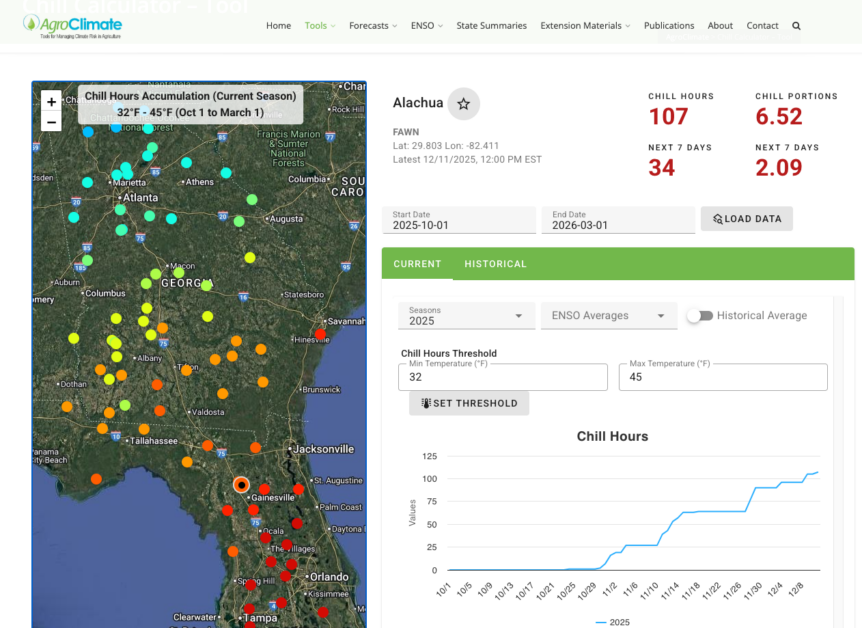
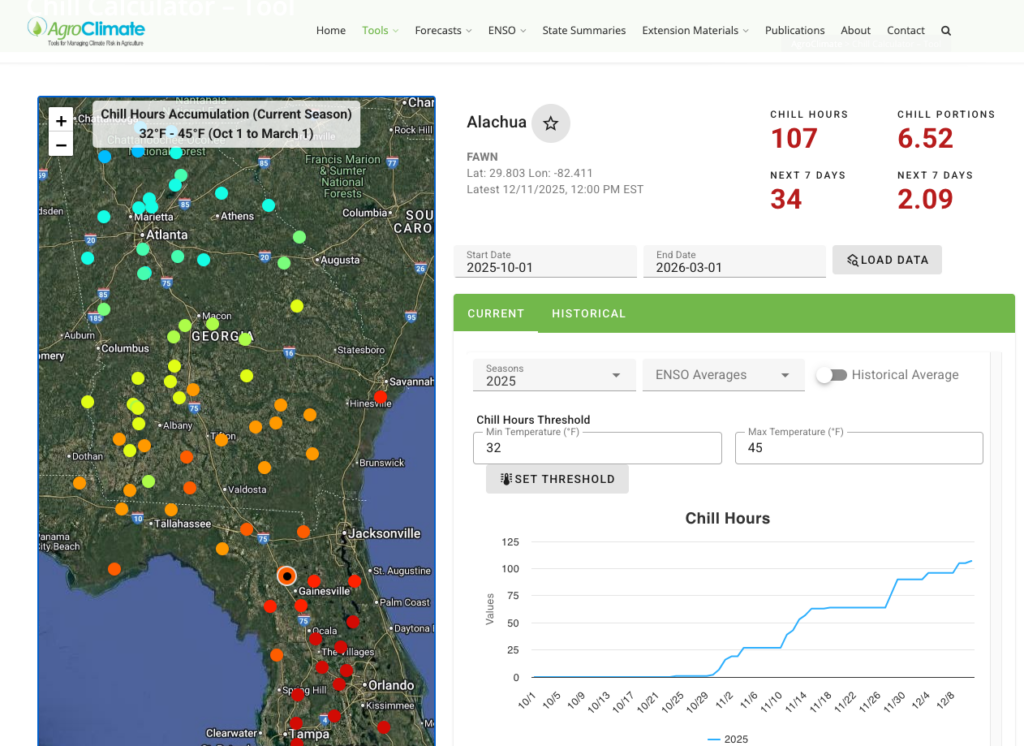
“The data corresponding to these two models is easily accessible in our UGA Weather Network (is.gd/UGAweather) or in AgroClimate (agroclimate.org/tools/chill-hours-calculator),” Chavez says. “At both sites, you will find a drop-down menu or be able to select a specific weather station (close to your location) to see how much chill has been accumulated. We normally select the dates between Oct. 1 and Feb. 10. There are two options for the chill degree model to be selected as described above.
“Sadly, we don’t have access on the UGA Weather Network website to the Dynamic Model. We have found in the last years that the Dynamic Model is proving to be better suited for our temperature variations accounting for gain and losses of chill. The site that I have been using for obtaining data for chill portions is Climate Toolbox (climatetoolbox.org/tool/historical-climate-dashboard).
“One exciting new option was added recently in the AgroClimate website. This is a chill tool that includes the traditional models, but also the Dynamic Model. The website for this tool is http://agroclimate.org/chill-calculator-tool. This works like the traditional tool in AgroClimate, but with the new added feature of providing us with chill portion data for a location. This is quite exciting as we didn’t have such an option before with the UGA site or AgroClimate.”
Chavez also encourages growers to utilize the Smartirrigation Peach app, which has added a new winter feature. The app can be downloaded to Android and Apple devices. The app provides data on chill accumulation for orchards in Florida and/or Georgia. It also supports the Weinberger, the Modified Weinberger and Dynamic models.
See a blog post from Chavez at is.gd/ChillTools for more detailed information on how to utilize various chill-tracking tools.
Video Component
Click here to view video.