









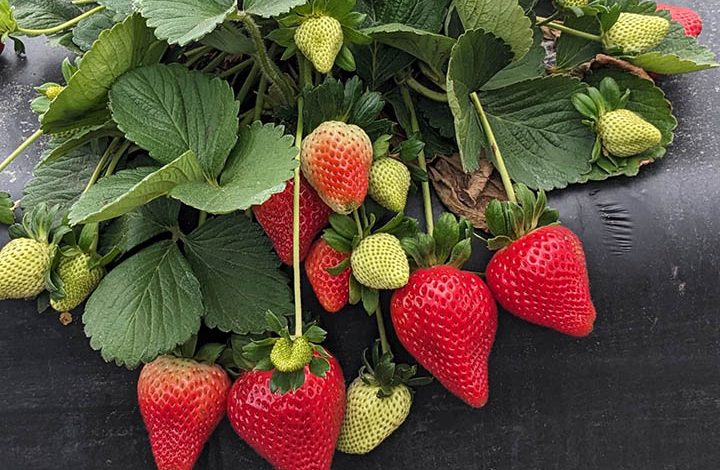
By Frank Giles
Vance Whitaker has led the strawberry breeding program at the University of Florida Institute of Food and Agricultural Sciences Gulf Coast Research Education Center (GCREC) in Wimauma since 2009. In September, Whitaker was recognized by the Florida Fruit & Vegetable Association (FFVA) with its Researcher of the Year Award. Specialty Crop Grower asked Whitaker about his breeding program and the honor.
Q-and-A
Q What has the experience been like leading the breeding program at GCREC?
Whitaker: It has been 16 short years! I was blessed to work alongside the previous breeder Dr. Craig Chandler during my first year. He provided valuable direction and excellent genetics to work with. I have enjoyed working with the other strawberry researchers at GCREC and the close collaboration we have. It is a team effort.
Q What are some of the priorities of the breeding program in terms of the varieties you are turning out?
Whitaker: Our priorities are timing and quality. We need fruit at the right time for the market and with the quality that distinguishes Florida strawberries in the grocery store. Flavor has been a major focus. Recently, disease resistance has gained even greater importance with the emergence of new strains of Neopestalotiopsis spp.
Q How long does it take to develop a variety before it is available to growers?
Whitaker: From the time we make the cross to the time growers have commercial quantities of a new variety is about five years. However, in the case of Ember and Encore, our two newest varieties, these were available in only four years. Shortening this timeline has been an important advancement in the breeding program.
Q Can artificial intelligence (AI) technology help with breeding new varieties?
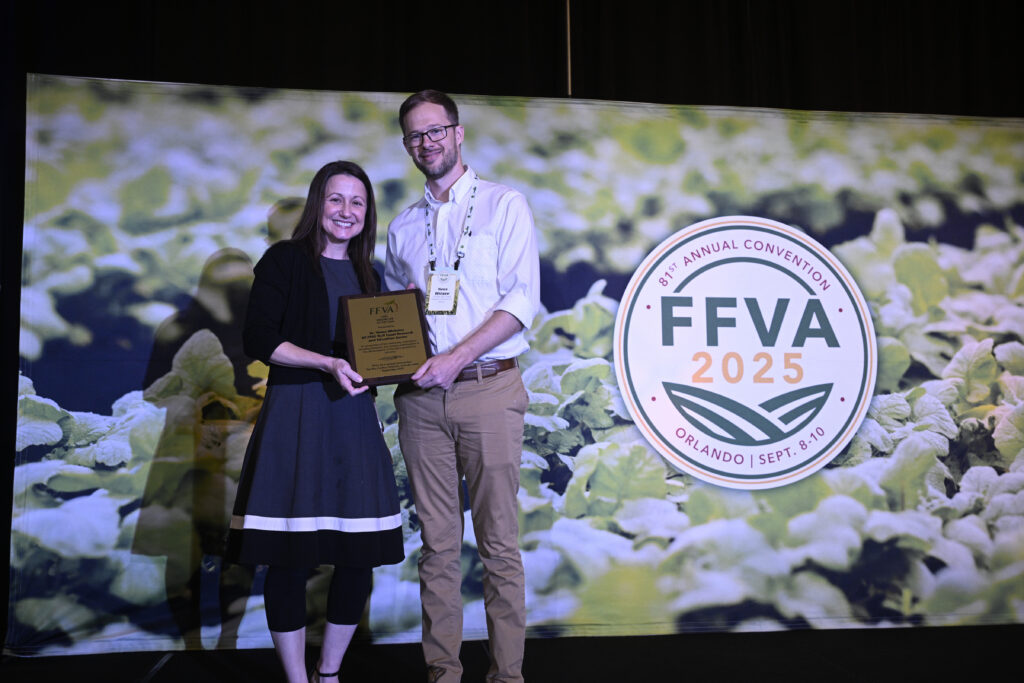
Photo courtesy of FFVA
Whitaker: We have already been using predictive analytics to a large degree in the breeding program, and AI has been a part of that. For example, we have worked with Dr. Kevin Wang and other agricultural engineers to collect large amounts of field data with drones. AI has been used to extract and analyze the data.
Ember and Encore
Q What can you tell me about Ember and Encore?
Whitaker: This is an exciting year, as we expect that Ember and Encore will make up nearly half of Florida strawberry acreage this season. They both have better disease resistance packages than previous varieties, with lower incidence of phytophthora crown rot and botrytis fruit rot.
Q Are you working on resistance to Neopestalotiopsis?
Whitaker: For several years now, resistance to Neopestalotiopsis spp. has been one of our top priorities. When more aggressive strains first emerged, we found very little resistance in our material. It has been an uphill battle, but Ember is less susceptible than our previous varieties, and we have some highly resistant material coming through the program now.
Q Of the currently available varieties, which are the most popular with growers?
Whitaker: Florida Brilliance is a workhorse that yields early and has high productivity throughout the season. Medallion has fantastic flavor and can be planted very early but is more disease susceptible and more difficult to grow. We are seeing a rapid shift to our new varieties Ember and Encore because they are combining these characteristics with a tougher plant and better disease-resistance package. Ember also has excelled in organics.
What’s Coming Next?
Q What varieties in the pipeline are you excited about?
Whitaker: I am most excited about the combination of disease resistance and flavor that we have coming through the program. Right now, improving these characteristics is more important to us than increasing total yield. Overproduction can be a problem at certain times in the season. Flavor will help keep demand strong, while better resistance will reduce input costs and risks for growers.
Q How was it to be honored by FFVA as Researcher of the Year?
Whitaker: First, I want to recognize that there is a whole team of wonderful people in the breeding program that made that award possible. It’s a recognition of their work just as much as it is of mine. Second, it means a lot to me that strawberry growers supported the nomination. I am here to serve them, so it means a lot to me that they felt our program was deserving of recognition.
Video Component
Click here to view a video interview with Vance Whitaker.