









By Clint Thompson
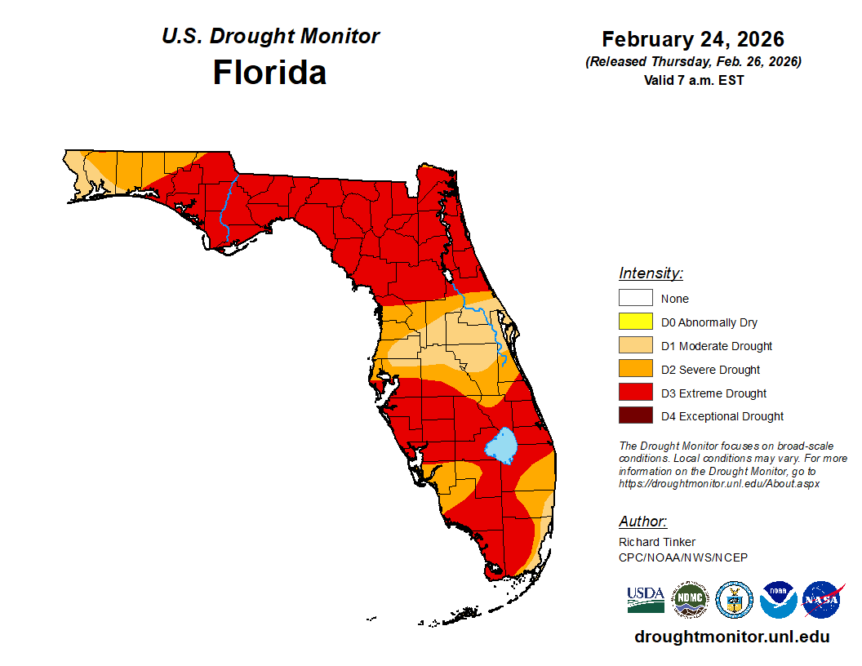
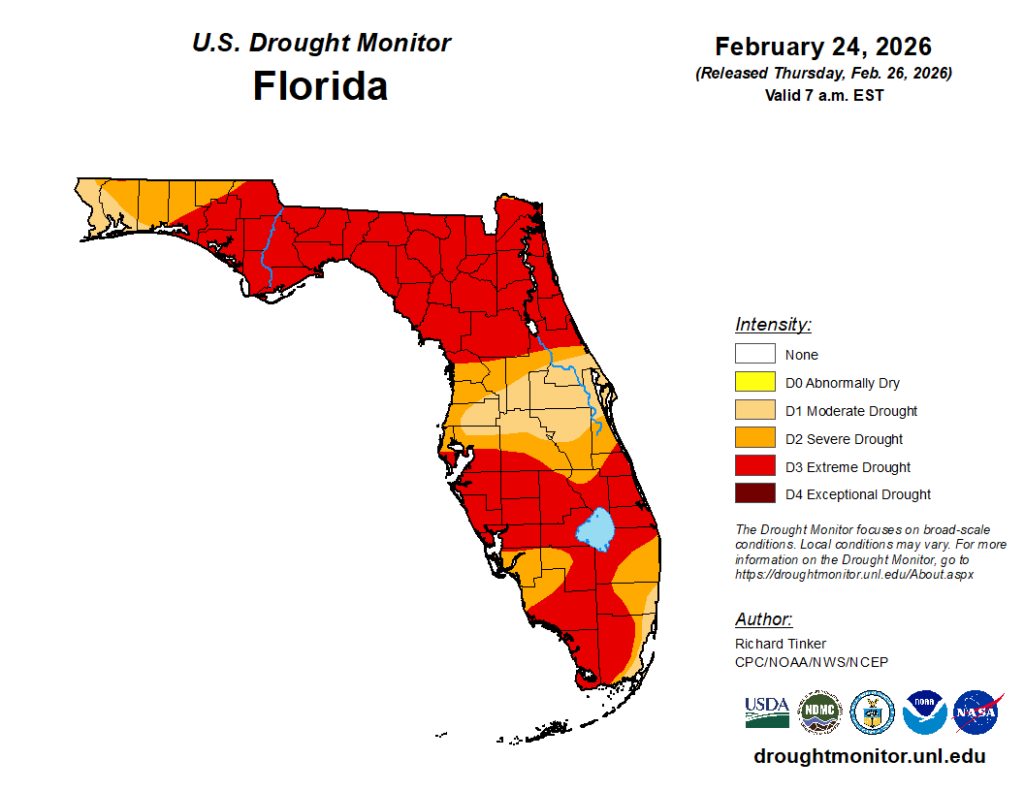
Extreme drought conditions are still prevalent throughout North Florida, expanding from the Panhandle all the way as far south as Citrus and Sumter counties, according to the U.S. Drought Monitor.
They are challenging conditions for the watermelon producers in the Suwanee Valley who are beginning to plant this year’s crop.

Bob Hochmuth, University of Florida Institute of Food and Agricultural Sciences (UF/IFAS) Regional Specialized Extension agent in Live Oak, Florida, discussed the tough scenario facing his growers.
“It’s difficult and not advisable to put plastic down on extremely dry beds. They’re just difficult to rewet with drip irrigation,” Hochmuth said. “For us down here, essentially everything is drip irrigated. If they’ve got the plastic laid, they would have been able to trigger and start the drip irrigation to get moisture, sufficient moisture levels in the bed, so that they’ve got good moisture by the ability to wet it with drip irrigation when they go to planting.
“We want to make sure they’ve been able to get adequate moisture built up in the bed by using the drip irrigation.”
Drip Irrigation
Hochmuth said there are multiple methods where the plants are irrigated once they are put in the ground.
“One is that they’re walked in. Holes are punched without water, and then the labor force walks down the row and puts them in by hand,” Hochmuth said. “The other one is, with the planting unit itself, there’s a water wheel and you can put small amounts of water in each hole as the hole is punched. That’s another way you can get moisture.
“In the event that things are really dry and they’re just lucky to get them in the ground, then the final option would be they would be able to go in with a water wagon, a big tank and have a water spicket over top of the row that, as they drive down the row, water would be deposited on the plastic. Most of that would run into the hole where the plant is located.
“Those are some of the options once the plastic is laid.”
Hochmuth added that farmers that have fields with a pivot irrigation system could have used them to wet the fields before laying plastic.