









By Kevin Barley
As growers seek alternative crops, bamboo has been considered, especially on ground fallowed after citrus greening has taken out groves across the state of Florida. Researchers at the University of Florida Institute of Food and Agricultural Sciences (UF/IFAS) have been searching for viable alternative crops. In 2016, a small bamboo farming industry began developing in Florida, gaining the support of UF/IFAS.
Bamboo proved to be a strong alternative crop candidate. It grows rapidly, produces both food and timber, and thrives in Florida’s warm climate with well-drained soil and reliable water.
Bamboo shoots already serve a large established market. Each year, approximately 60 million pounds of canned bamboo shoots are imported from Asia into the United States. Florida’s Citrus Belt appeared ideally suited to supply this demand domestically. But the early years involved trial and error. There was little guidance available on best farming practices, and growers had to build the model from scratch.
Figuring Out Harvest Frequency
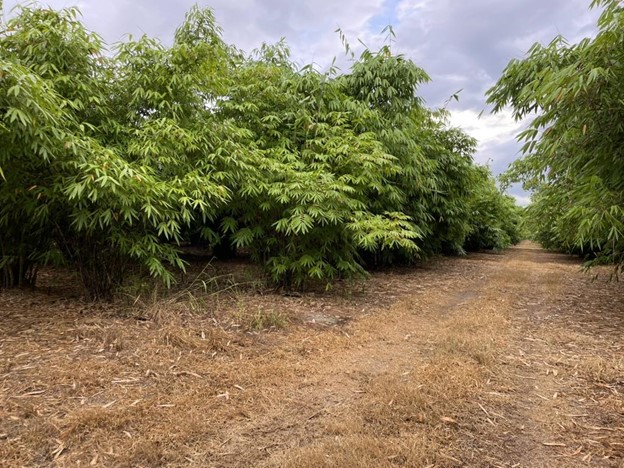
As the industry expanded to more than 1,000 acres, farmers refined cultivation practices and organized them through the Florida Bamboo Growers Association (FBGA). Working with UF/IFAS, the FBGA launched the Key Project to analyze production by farm year and predict income potential.
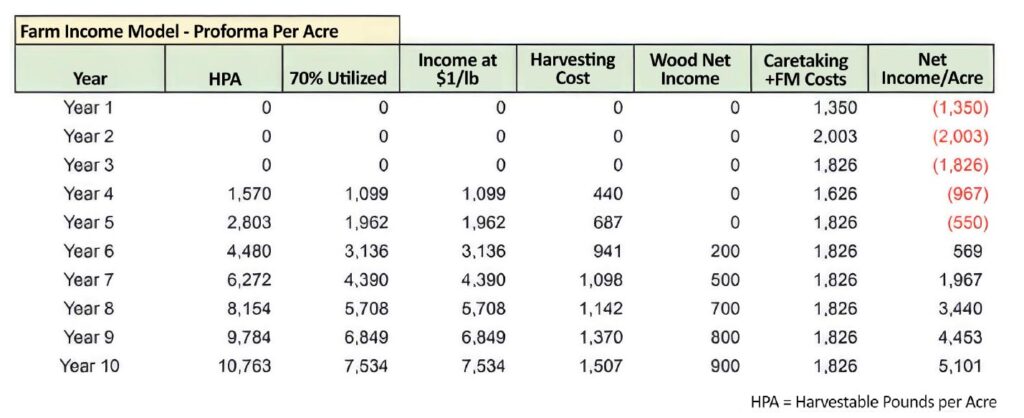
Based on plant production data, farms appeared capable of generating over $5,000 per acre in annual profit. However, harvest volumes told a different story. The production was there, but the harvested crop was far below what data suggested was possible.
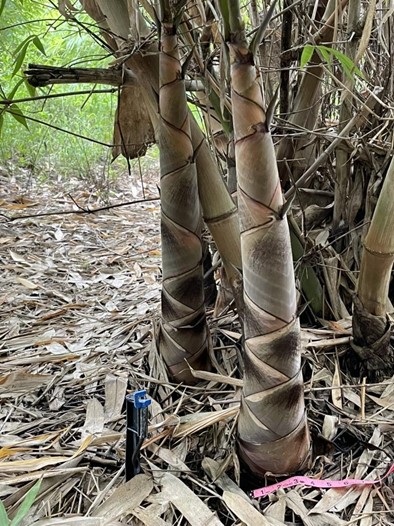
The primary crop is bamboo shoots — a nutritious vegetable harvested from the base of emerging culms. Florida grows Dendrocalamus asper, which produces shoots 4 to 6 inches in diameter that can eventually reach 50 feet tall. Shoots are harvested when they are 10 to 20 inches tall. After that, they quickly become woody and unsuitable for food processing.
During the first four years, industry-wide yields ranged from 15,000 to 25,000 pounds annually. In year five, just over 50,000 pounds were harvested. The Key Project, led by Don Rockwood of Florida Fast Growing Trees with data coordination by Cathy Atchley of OnPoint Ag, monitored 25,000 new culms across representative plots. The data showed far more production than the harvests reflected.
In 2023, it was calculated that only about 2% of the available crop was harvested. This was both confusing and alarming. The answer became clear through direct observation. On one farm, there were several large shoots about 1 foot tall, which are perfect for harvest. Two weeks later, they were gone. Looking up, they were 15 feet tall. These shoots had grown nearly a foot per day.
Because shoots are marketable only between 10 to 20 inches in height, the harvest window is effectively one day. If crews were not present during that narrow window, the crop would be lost to wood production. The core problem was discovered: harvest frequency.
Historically, farms were harvested once every week or two. That schedule simply could not capture a crop that matured in 24 hours. Growers shifted to harvesting twice per week.
The results were immediate. Harvest percentages increased dramatically, approaching the 70% target threshold. Growers intentionally avoid harvesting 100% of shoots to allow some to mature into culms for long-term plant health and future timber production.
As harvesting intensified, volumes surged. Growers wondered after a big harvest on Monday if they could get any harvest on Thursday, but it was there. Managing twice-weekly harvests required coordination. Equipment breakdowns, labor inconsistency and logistics posed real challenges. Ultimately, growers averaged 1.2 harvests per week across farms.
Analysis confirmed the impact of frequency:
- Farms harvested 0.8 times per week achieved only 21% harvest.
- Farms harvested 1.2 times per week achieved 60% harvest.
The higher-frequency group achieved nearly three times the harvest percentage. With improved logistics, reaching a 70% target became realistic.
Getting a Handle on Harvest Costs
However, another challenge quickly surfaced. Because bamboo is a new crop, harvest crews lacked experience. Contractors were unwilling to work on piece rates and instead charged hourly rates with no productivity controls. In some cases, harvest costs exceeded $1.00 per pound, which is the full market value of the shoots. At a crop value of $1.00 per pound, harvest costs at or above that level made profitability impossible. Fear of excessive harvesting costs discouraged farmers from increasing harvest frequency, limiting both farm income and industry growth.
This past season, a processing company called Florida Fresh Bamboo (FFB) was formed to purchase and jar shoots for sale in Asian American grocery stores. FFB introduced a transformative solution: They assumed responsibility for harvesting. Instead of unpredictable hourly billing, they charged a fixed 30 cents per pound harvest fee. They purchased shoots for $1.00 per pound, less the 30-cent harvest cost, resulting in a net 70 cents per pound to farmers.
Farmers responded enthusiastically. Every harvest meant predictable revenue. Meanwhile, FFB recognized that consistent volume was essential to operate efficiently. By assuming harvest risk, they gained the ability to manage and control it. If you own the risk, you can manage the risk.
Industry Potential
With reduced uncertainty and documented performance, investor confidence is growing. What began as experimentation has matured into a structured agricultural model. Bamboo farming represents a viable, scalable alternative to citrus in Florida.
Kevin Barley is the president of the Florida Bamboo Growers Association.