











By Frank Giles
When the United States-Mexico-Canada Agreement (USMCA) went into effect in July 2020, specialty crop growers in the Southeast were disappointed the replacement of the North American Free Trade Agreement did little to protect their domestic interests and markets.
When the agreement was crafted, it included a provision that the USMCA would undergo a joint review to assess its performance and continuation. That review is scheduled to begin on July 1, 2026.
During the process, each country conducts internal consultations and solicits input from stakeholders, including industry sectors like agriculture. Those sectors can submit recommendations for improvements to the agreement.
Industry Weighs In
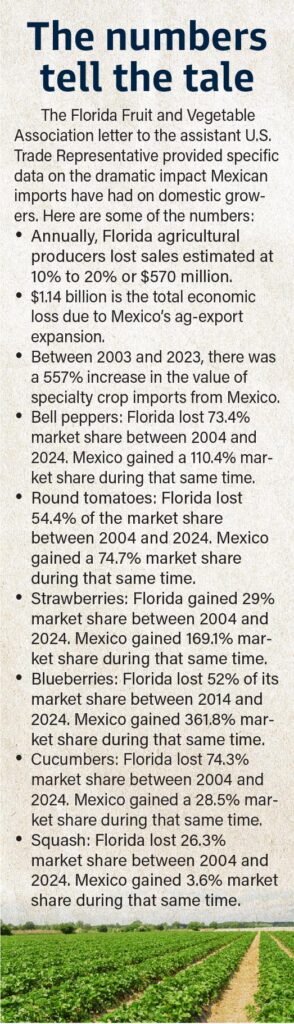
Specialty crop representatives in the Southeast have taken the opportunity to ask for more protection of their markets as the review process gets underway. In November, the Florida Fruit and Vegetable Association (FFVA) sent a letter to Daniel Watson, assistant U.S. Trade Representative, with comments seeking improvements to the USMCA.
The letter noted Florida’s important role in producing crops in the fall to late spring marketing window. It also noted that the Sunshine State is the nation’s leader in watermelon and sweet corn production. The state is second in the nation in production of strawberries, bell peppers and field-grown tomatoes. Florida is effectively the winter fruit and vegetable capital of the United States.
The market window for Florida and other states in the Southeast overlaps with Mexico. The FFVA letter outlined how this has challenged domestic growers:
“Since the early 2000s, (Florida) has had to compete in the U.S. market with unfairly priced, skyrocketing imports of Mexican seasonal and perishable fruits and vegetables. Over that period, in large part due to extensive financial benefits provided by the Mexican Government to its fruit and vegetable producers, the Mexican produce industry has enjoyed exponential production growth and export gains in the U.S. market.
“Its surging produce shipments to the U.S. market have had crippling effects on the produce growers in Florida and throughout the Southeast and are now threatening the viability of the Florida produce industry. To help safeguard the Florida industry, FFVA urges the U.S. Government to incorporate into USMCA effective, product-specific tariff rate quotas (“TRQs”) governing fruit and vegetable imports during Florida’s fall-spring marketing period.”
Lawmakers Speak Up
In March, Florida Congressman Vern Buchanan and Senator Ashley Moody sent a letter to the Trump administration on behalf of the full Florida delegation calling for action to protect Florida growers.
The letter cited the application of TRQs as a method to protect growers.
“Unfair Mexican trade practices are putting American farms, jobs and our national food supply at risk,” stated the letter. “The administration has an opportunity during the USMCA review to restore balance and stand up for Florida growers by implementing targeted TRQs that ensure our farmers can compete on a level playing field.”
Odds of Success
As the review process moves forward, representatives from the three countries will have to negotiate their recommendations. Much of the footwork should be completed before the July 1 review meeting.
In practice, the core joint review meeting is tied to July 1, 2026, but the surrounding negotiations and resolution could span from early 2026 preparations through mid-2026 (potentially four to six months or more of active bilateral/trilateral talks), depending on complexity and political priorities. Current indications point toward an intent to conclude decisions aligned with the July 2026 milestone rather than an open-ended process.
The chances that the specialty crop sector gains concessions in the review process, including TRQs, is up in the air. Some rank the odds at about 50%. Southeastern fruit and vegetable growers face the same challenge as always in these trade negotiations — being a small player in the overall agreement.
Mexico will likely defend its position without significant tradeoffs in the deal. Mexico and Canada are expected to prefer minimal changes or other side trade agreements over rewriting the USMCA agricultural chapter.
The Trump administration has signaled support for the specialty crop industry, as was evidenced by the termination of the Tomato Suspension Agreement in 2025. So, there is a chance for some positive movement for specialty crop growers. But the chances for an agreement on specific TRQs will be harder to achieve.
Digital: Don’t miss the digital edition of this issue to learn more about the USMCA review.