









By Clint Thompson
Harvest season is just around the corner for Southeast peach producers. For Lane Southern Orchards in Central Georgia, this means working round the clock this time of year.
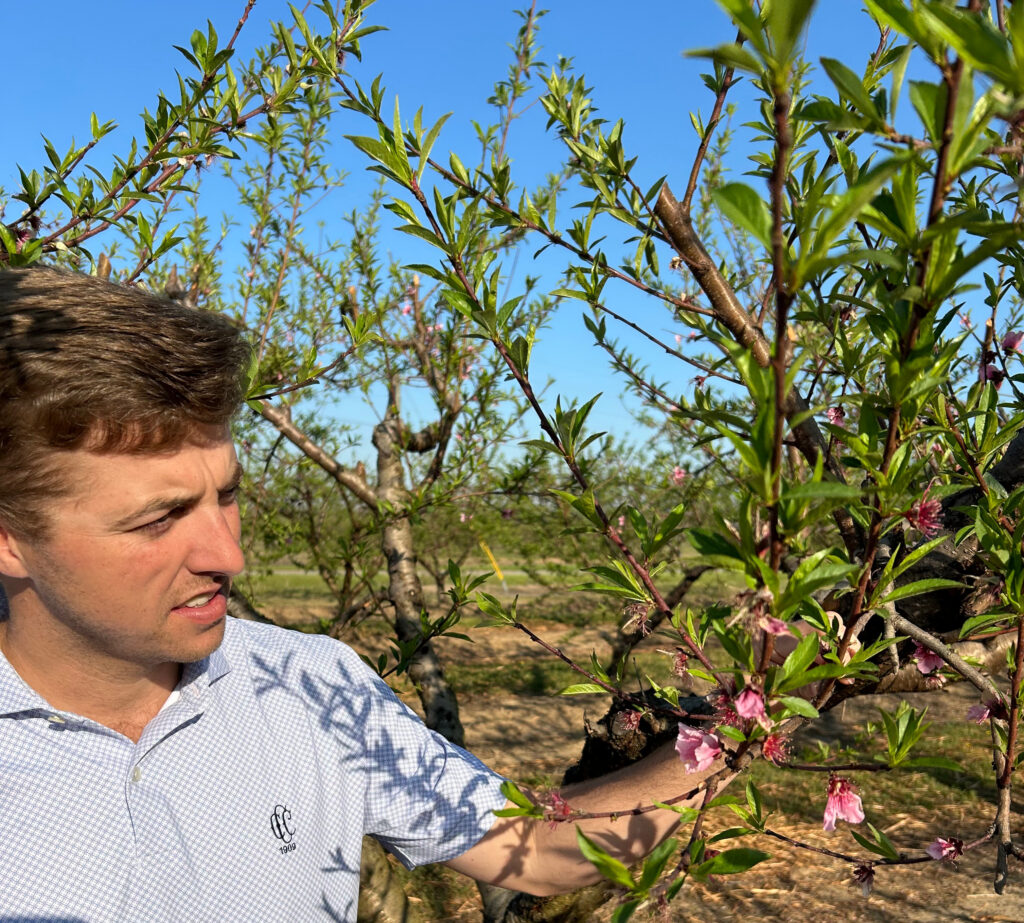
“The H-2A contracts start in February, so that’s when peach season starts,” says Tyler Wainwright, farm manager for Lane Southern Orchards. Wainwright oversees production practices in peach orchards west of the Flint River. That management involves pruning, harvesting and day-to-day operations. The company encompasses about 5,000 acres in total.
“The first thing we do is plant, and then we start pruning right when the H-2A labor gets here,” says Wainwright.
Photos courtesy of Lane Southern Orchards
Not long after that, Wainwright oversees one of the largest peach-harvesting operations in the state. Harvests start picking up around May 10 and last through approximately Aug. 10, depending on how quickly the fruit ripens. Peak volume is usually around the end of June or the first of July. Other than the mid-March freeze event, peach producers have experienced mostly ideal weather conditions this season. This year is expected to provide another strong crop.
“We’re really excited about how the crop is shaping up,” Wainwright says.
Secrets to Success
While the company’s retail store and restaurant are located just outside of Fort Valley, Lane’s footprint is spread out over most of the central part of Georgia. That distribution allows production to not be concentrated too heavily in one area, providing some insurance in case of a late-season freeze.
“We’ve got a pretty wide footprint across middle Georgia and into Blakely County. Spreading out like that allows us to capitalize on the best locations and hedge our bets against a violent hailstorm or freeze. Anything we can do to diversify the ability to make the crop is going to be a positive,” he says.
Another secret to the company’s success is how it leans on traditional production knowledge while embracing modern technology and improvements in agriculture.
“Integrating all of that together gives us the best chance of having a crop,” Wainwright notes. He cites drip irrigation and GPS planting as examples of technology that increase the operation’s efficiency.
Other key factors in the farm’s success are knowing where to plant new trees and planning for when the fruit will be ready. Wainwright starts picking new trees in their third summers of growth. He says growers can achieve 15 to 16 years of production on good soil where there had never been peach tree production before. However, if it is trees behind trees, it may be closer to 12 years.
“Ideally, you would like to row crop for two or three years and build some of that dirt back up, take some of the existing disease and nematode pressure down and let that ground rest,” Wainwright says. “We do have some farms, based on elevation or logistically are in a lease, where it is trees behind trees.”
Pruning Process
Before sweet, delicious peaches can be harvested and sold, trees must be pruned. This production practice creates a growing environment more conducive to larger, sweeter peaches that are highly sought after in grocery stores and fruit stands.
“Let’s just say you want to cut it down to 200 limbs. You’re resetting that tree,” Wainwright says. “The more limbs you leave on it, the more blooms you’re going to have, but the peaches will be smaller. It’s a fine line of give and take between big, good-quality fruit and too many small peaches. They still eat fine but are a little harder to market.”
According to the University of Georgia, pruning helps develop proper shape and form of trees and vines, ensuring good fruit quality. Pruning invigorates new growth and enhances the ability of a plant to develop high-quality fruit, which is more marketable.
“The traditional tree, let’s say we prune it once, maybe prune it a second time, thin it one time and then you might pick that tree between four and six times, depending on the variety,” Wainwright says. “When you start picking a peach tree, ideally, you’d love to pick it, skip two days, pick it again, skip two days, pick it again. Then maybe only skip one day on the back end. A lot of people think you only pick them one time. But when that variety’s ready, you harvest it anywhere from a seven- to 20-day window.”
Challenging Times
Like other farming operations, Lane Southern Orchards is not immune from the annual concerns that come with being a crop producer. Freeze events are the biggest worry every year, like what occurred on March 10–11. The cold-snap was expected to impact early-season varieties.
Labor regulations are also high on the list of challenges.
“All the peach growers around here are H-2A driven. It’s a very rewarding process for workers because they receive a guaranteed wage. They in turn provide us with great labor, but sometimes there are external factors at the border, and you’re always worried about that,” Wainwright says.
Then there’s the issue of finding new places to grow trees.
“Our biggest challenge is finding fresh ground with a good elevation so you can hedge against a frost event,” Wainwright said.
Despite the challenges that seemingly stack up against peach producers, Wainwright stresses that there have been three years of strong peach production. That has provided momentum for the industry.
“We’re heading in the right direction,” concludes Wainwright.
Video Component
Click here for video component.