









To make a successful return on their investment, growers need to accurately predict how much crop they might produce in a given season. University of Florida Institute of Food and Agricultural Sciences (UF/IFAS) researchers are developing web-based tools that incorporate artificial intelligence to help producers with yield predictions.
Such forecasts are critical. In Florida, the production value for strawberries was $714 million and $532 million for tomatoes in 2025, according to the U.S. Department of Agriculture National Agricultural Statistics Service. The goal of the web tools is to provide growers fast, accurate estimation and prediction of yields, rather than making economic projections based on manually counting the crops or historic data that can vary greatly.
Kevin Wang, an assistant professor of agricultural and biological engineering at the UF/IFAS gave strawberry growers an update on the two-step applications, known as PhenoSeg and PhenoSnap, at the AgriTech conference in Plant City on May 5. Wang is also lead author on this new Ask IFAS document, which details these tools.
PhenoSeg
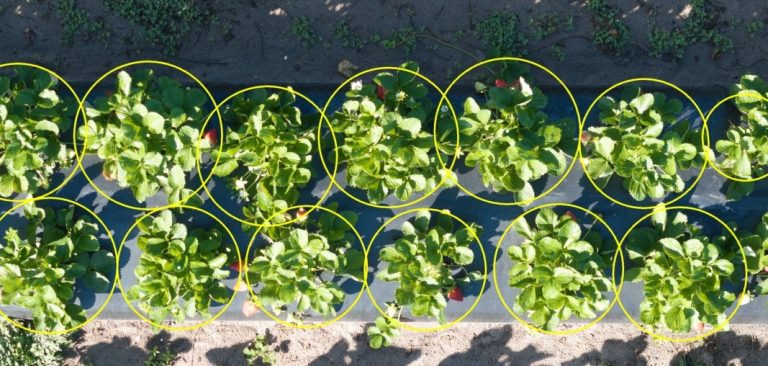
PhenoSeg focuses on segmenting individual strawberry plants from drone imagery – essentially isolating each plant from the background so scientists and growers can count plant-level fruit and flowers more precisely.
PhenoSnap is the UF web-based application that detects and counts fruit, flowers and runners on strawberries. It can also count tomato fruit and flowers.
Both applications are hosted on UF’s HiPerGator, the nation’s fastest university-owned supercomputer. Because they’re on HiPerGator, researchers and growers don’t need to install any software or have powerful computers, Wang said. They can get the results by uploading images through a web browser.
During the 2025–26 growing season, scientists collected drone imagery on the research farm at the UF/IFAS Gulf Coast Research and Education Center (GCREC) as well as on two commercial growers’ farms.
“The results so far are encouraging,” said Wang, a faculty member at GCREC. “PhenoSeg’s plant segmentation is performing well. PhenoSnap’s fruit and flower counting still tends to undercount, which is a known limitation we’re actively working to improve in the next phase of development. We want to be transparent about that – the software application tool works, but the vision models and the algorithm supporting the software still need refinement.”
How the System Works
The system works like this: A drone flies over a strawberry field and captures high-resolution color images. Compared to walking rows by hand or using a ground-based scouting platform, drone-based data collection covers far more ground in far less time, saving growers money and time.
After the flight, images are downloaded from the drone camera to a computer and uploaded to PhenoSeg, which handles plant segmentation first. It isolates each individual plant, so the system knows what it’s viewing. Those plant-level images are then uploaded to PhenoSnap, which counts the fruit and flowers on each plant.
Wang is working on this project with Wael Elwakil, fruit and vegetable extension faculty with UF/IFAS Extension Hillsborough County and Shinsuke Agehara, associate professor of horticultural sciences at GCREC.
He also credits UF/IFAS strawberry breeder Vance Whitaker and UF/IFAS tomato breeder Jessica Chitwood-Brown – both of whom also work at GCREC – calling them “instrumental in shaping the fruit and flower detection models for each crop.”
Wang and his colleagues want to extend the use of the applications to other commercial farms.
“If any growers are interested in trying the tools, we’re very open to that,” he said. “We can walk them through the workflow and collaborate with them to adapt and improve the process for large-scale commercial use. That kind of real-world feedback from growers is exactly what will help us make the tools better.”
To find out more about the web-based tools to predict crop yields, growers can contact Wang at xuwang1@ufl.edu.