









By Clint Thompson
Pecan producers in Georgia and Alabama are on the cusp of harvesting this year’s crop. But they can ill-afford to let their guards down with regard to the crop’s current needs, which right now, centers on water demands. This is according to Lenny Wells, University of Georgia Extension pecan specialist.
Wells talked about pecans and their water needs in an interview with AgNet Media.
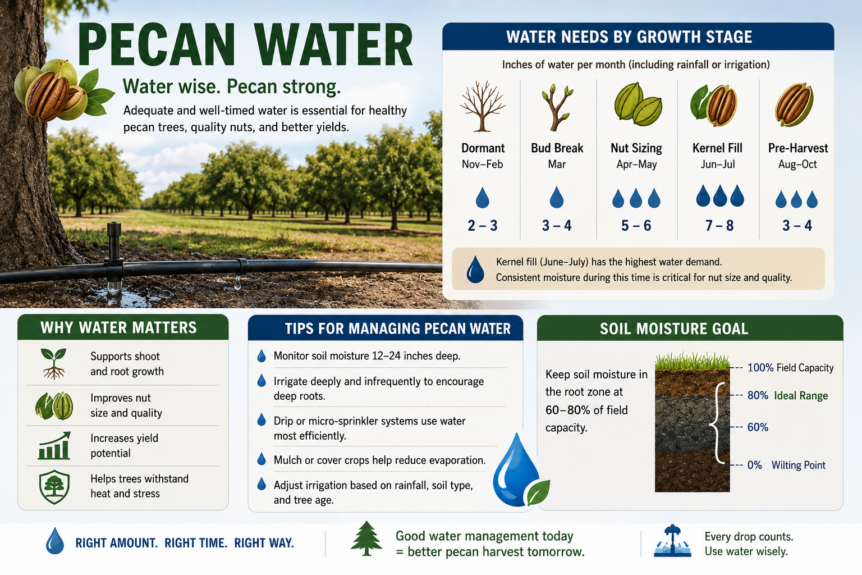
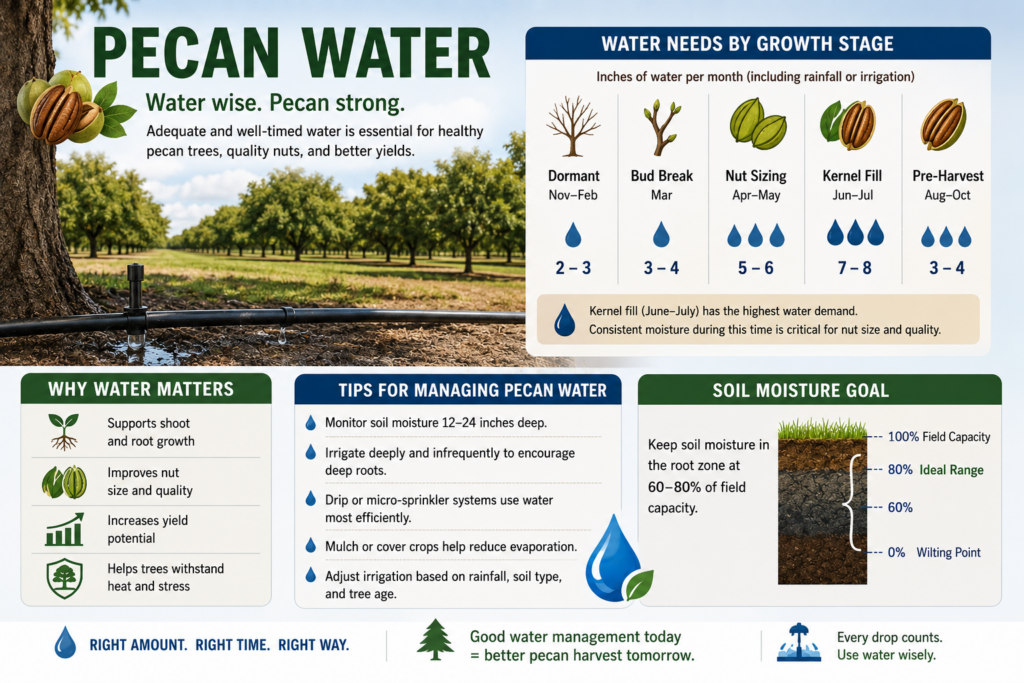
“The big thing at the moment is water. Kernel filling stage is the time where there’s this kind of peak water demand. They really need the water,” Wells said. “We’re at basically 100% on our irrigation right now through the middle of September to try to fill those nuts. And then after that, I think sometimes growers can fall into the trap of thinking, well, the kernels are filled, and I’m done. I can cut my water off.
“They still need water after kernel filling to open those shucks properly. They don’t need near as much water as we’ve been giving them up until those kernels get filled. We can cut back, but we can’t cut it off.”
Pecan Research
Wells has also learned from research students in recent years that the tree’s physiology shifts after kernel filling. It starts slowing down on the water’s uptake which can become problematic during hot and dry periods in late September and October. It’s not as efficient in taking up water.
“Even if you’re watering 12 hours a day, which we wouldn’t recommend during that time in October, even if you’re watering that much, it’s not a matter of whether you’re not giving the tree enough water, it’s just that the tree is not capable of taking it up at that time as quickly as it needs or as efficiently as it needs,” Wells said.
“That’s because we’re irrigating only a small percentage of that root system. And earlier in the year, when the tree is really good at picking up that water and highly efficient at picking up that water, oftentimes that’s enough. But when this physiology of that tree shifts and it starts to slow down and that uptake is not as efficient, that small percentage of that root zone that we’re watering is not able to get all that it needs. And so just one or two rains, one or two good rains of an inch or more in late September and in October, it makes all the difference because then they’re getting water over the whole root zone and can adequately hydrate.”