









By Clint Thompson
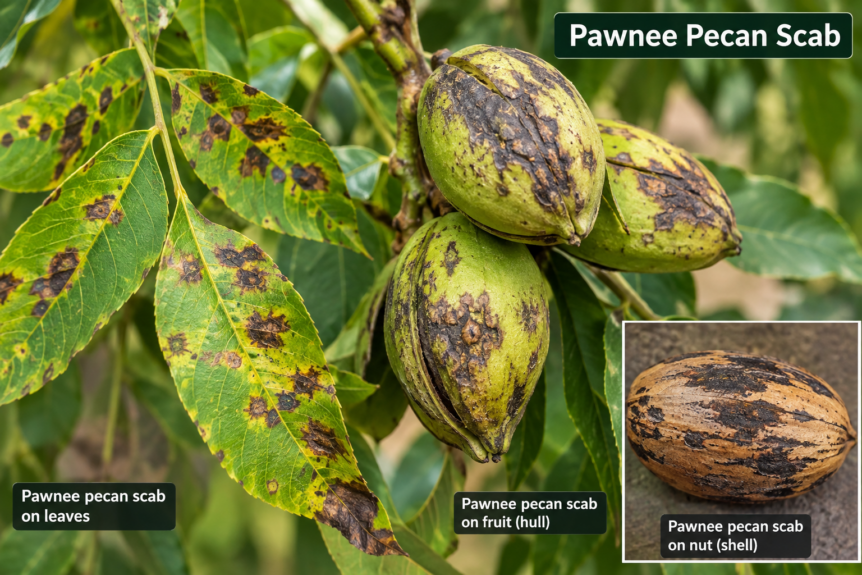
Scab disease’s devastating impact on the Pawnee pecan variety is forcing one South Georgia farmer to revamp his production strategy.
“I’m taking Pawnee out this winter, and that’s where I’m at,” said Buck Paulk, located in Ray City, Georgia. “It’s like after Hurricane Helene last year, it went off the deep end. I mean, it’s done like I’ve never seen it before.
“You can have some bad scab. Most years you can deal with it, but this is like another animal.”
Pawnee’s Popularity
Pawnee is a popular variety because it is one of the first to be harvested. It allows growers to take advantage of an early marketing window. But it is also one of the most susceptible varieties to scab disease.
“Looking long term, we’re not planting Pawnee here anymore,” Paulk said. “I’ve got an aggressive 10-year plan if major hurricanes stay out of the way. Over the next 10 to 12 years, I’m working out of Desirables, and Pawnee was part of that. But now it’s caused them to be from the latter part of that schedule to the front part.”
Pecan scab disease was high this year in some areas in Georgia, according to Lenny Wells, University of Georgia Extension pecan specialist.
Scab Background
Scab is a fungal disease that infects the leaves or nuts of pecan trees. If scab impacts the nut early enough in the production season, it can cause the nut to blacken and fall from the tree. It excels on trees that have received moisture. However, the disease’s impact is minimal once pecan shells start to harden.
Wells classified this year’s pecan season as one of the most “high-pressure seasons,” he’s ever seen. Paulk agrees with that assessment.
“My scab with Pawnee has gotten so bad that, I’m trying to wait around where I can get them in one shake on some of this because the crop is so damaged. It’s the second year in a row this has happened,” Paulk said. “I’ve got a strain of scab in Pawnee that is in this location. It’s just not controllable. For two years in a row and I’ve had, I can’t, I don’t want to go do it again.
“Maybe last year was a fluke, but it did the same thing again this year, even with increased measures. I’ve got some Pawnee about nine miles from the main farms, not many, and they’re fine. And they were sprayed less than these,” Paulk added. “It’s a local population in my opinion. I’m no pathologist, but my observations and my opinion, I think this genetic strain of scab was happening in some localized spots in the field, and I think that maybe the hurricane did a really good job of spreading it through these fields.”