









By Clint Thompson
The Adverse Effect Wage Rate (AEWR) was designed to avoid having an adverse effect on American farmers. That has not been the case, however.
It’s a message that those in the agricultural industry voiced to legislative leaders amid spiraling AEWR wages used to pay workers in the H-2A program. It ultimately led the Department of Labor to issue an Interim Final Rule last October, introducing a new methodology for determining AEWR by using the Occupational Employment and Wage Statistics survey.
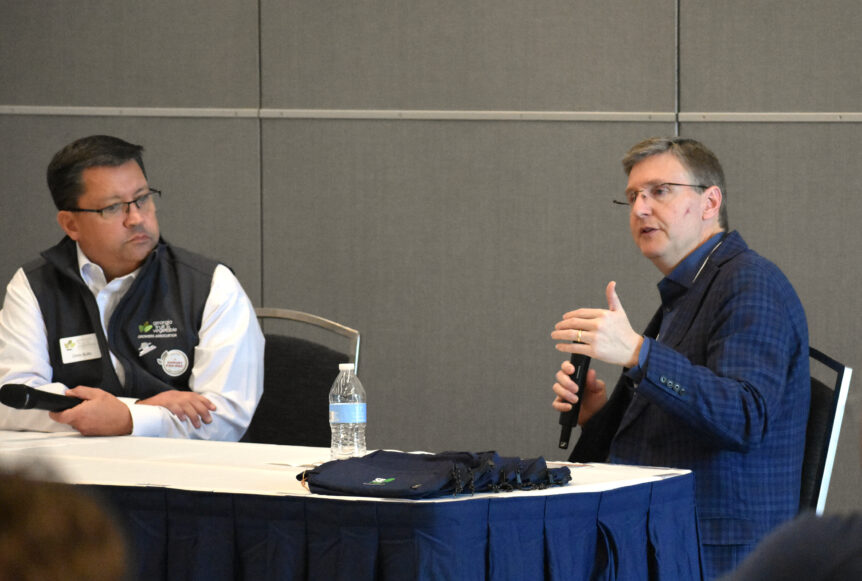
An advocate for farmers during these challenging years has been Ray Starling, general counsel for North Carolina Chamber of Commerce. He discussed AEWR at the Southeast Regional Fruit and Vegetable Conference in Savannah, Georgia, in early January.
Leader’s Message
“At the end of the day, for every farmer that’s been involved in using the H-2A program over the course of the last 20 years, they hear the phrase, Adverse Effect Wage Rate, and inside they both chuckle and cry,” Starling said. “In fact, what they’ve witnessed and been a part of over the course of the last two decades is the Department of Labor’s way of managing the Adverse Effect Wage Rate has actually, in fact, led in the industry to an adverse effect on American farmers. This is obviously not Congress’ intention with this program, but I’ve seen it first hand. In my own family, we have shifted out of the more hand intensive labor crops because of the cost of H-2A labor.
“About well over a year ago, I guess a couple of years ago, we started talking about, ‘How do we establish the narrative, how do we explain to the federal government, that the way that the AEWR is being set is actually in fact doing the very thing that it was designed not to do, which is to have that adverse effect?’”
How Bad Is It?
Florida’s AEWR for 2025 was $16.23 per hour, representing a 10% increase from 2024. The AEWR for Georgia and Alabama was $16.08 per hour, which also represented 9% increases.
Starling said the industry partnered with a retired economist from N.C. State University. His research verified what farmers and industry leaders had been saying all long.
“His research actually showed exactly what we thought it would that we were right about the adverse effect wage rate actually having an adverse effect. Once we were armed with that research, we were able to go have meaningful conversations with administration and folks on the hill and push for what they’ve ultimately done with this interim final rule that the Department of Labor published in early October,” Starling said.
The discontinuation of the Farm Labor Survey was viewed as a win by the specialty crop industry, as AEWR expenses dramatically increased over the last three years.