









By Frank Giles
In almost every conceivable sector, artificial intelligence (AI) is exploding onto the scene as it merges into our daily lives. Agriculture is no exception, as AI technology becomes integral in the agtech sector.
Some sources indicate that the U.S. market value of AI in agriculture has already surpassed $1 billion. Expectations are for that figure to rise. While adoption of AI-driven technology is accelerating with precision farming, robotics and predictive modeling, it still remains a small fraction of overall U.S. agriculture, which is a more than a trillion-dollar sector.
When it comes to some of the AI-driven technology, the cost will remain a barrier to adoption for some growers. However, the ability to use large language models like ChatGPT, Grok and Claude for free is an option many growers are taking advantage of to learn better ways to grow crops.
Data Collection and Decision-Making
AI is enhancing many sectors of what is considered agtech, including precision agriculture. It also is helping growers make better decisions with the large amount of data being generated by some crop-monitoring platforms.
The technology is being used to better analyze images generated by drones, airplanes or satellites. These images can show crop stress, disease, pest pressure and nutrient deficiency. AI also is enhancing weather-station data and soil moisture monitors in fields to improve irrigation and fertilizer use.
The Citrus Research and Field Trial (CRAFT) Foundation in Florida is utilizing drone imagery collected annually from groves participating in CRAFT programs. The foundation is responsible for funding the planting of thousands of new acres of citrus as growers try to bounce back from HLB.
Weed Management
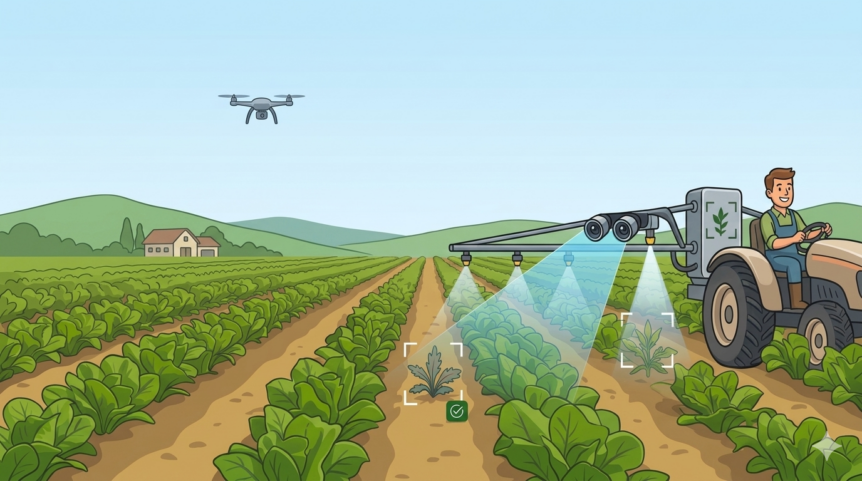
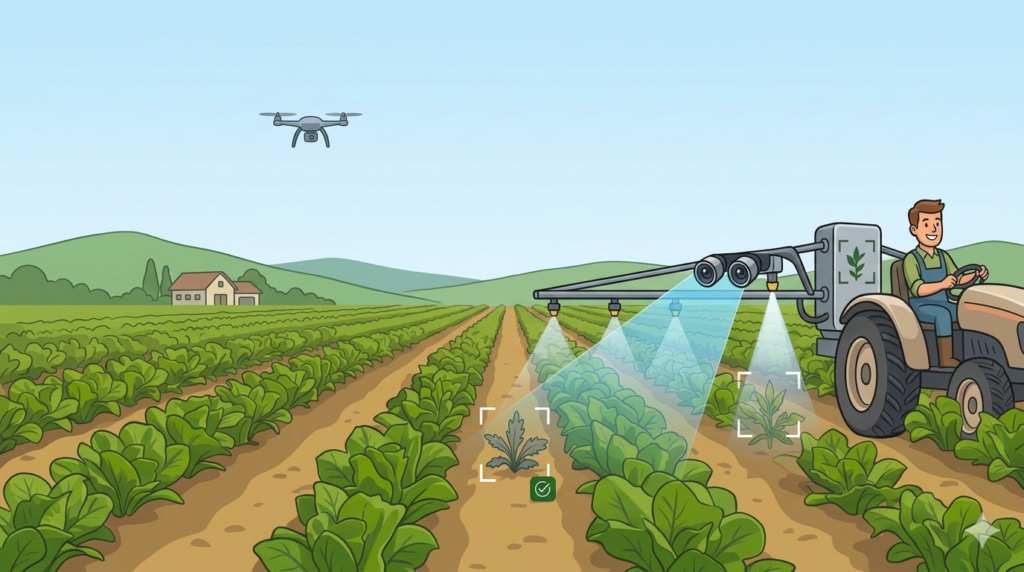
Weed management is one of the more rapidly emerging sectors where AI is helping to perfect systems that “see and spray” weeds or use lasers to zap weeds. The see-and-spray systems use cameras to detect weeds and spray them while avoiding the crop plants and areas where no weeds are present. In some cases, herbicide reduction has been in the 75% to 90% range.
Nathan Boyd, professor of horticultural sciences and weed science at the University of Florida Institute of Food and Agricultural Sciences (UF/IFAS), has developed a version of see-and-spray technology aimed at specialty crop production.
His technology works in plasticulture crops like watermelon, tomato and strawberry. The system identifies specific zones like transplant holes in the plastic, bare soil between beds, and areas where weeds like nutsedge puncture the mulch. Herbicide is applied precisely to those spots.
Laser weeders also use cameras to seek out the weeds. Through AI machine learning, these technologies continue to improve their ability to see and identify weeds in various stages of development. Carbon Robotics’ LaserWeeder is a technology that is being deployed in specialty crop production.
Predictive Models
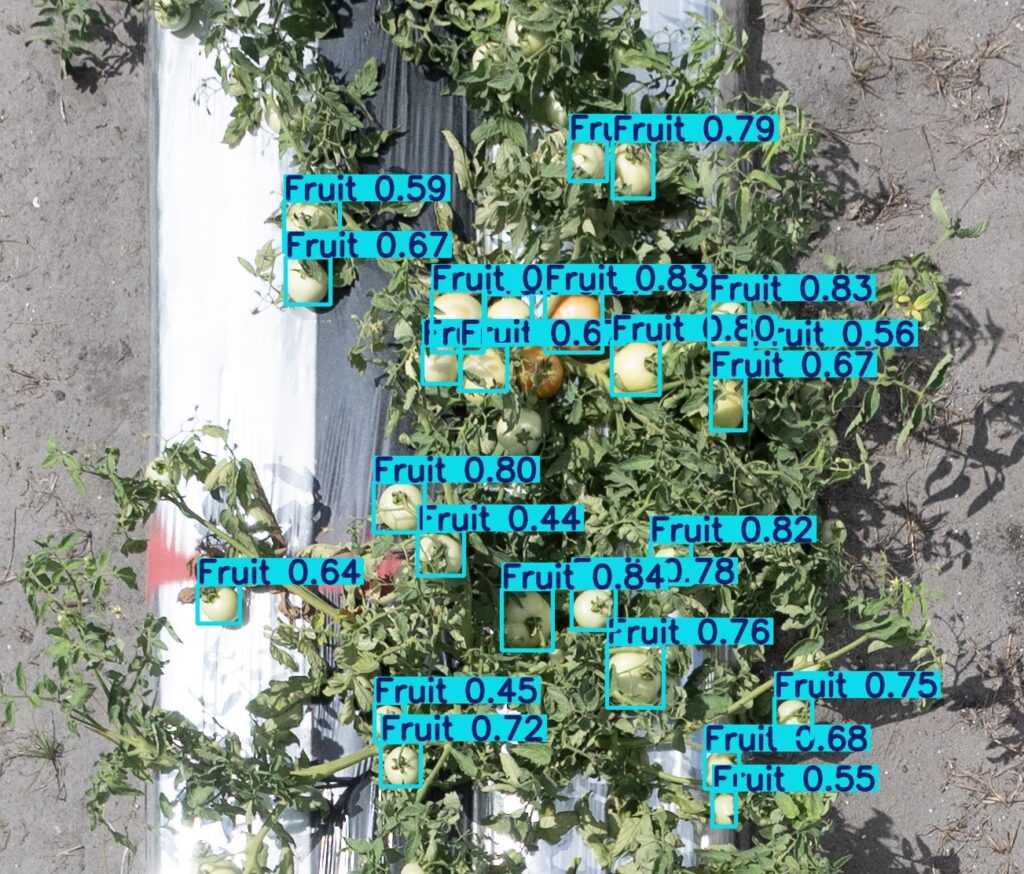
AI technology will also enhance predictive models for specialty crops, which is a big deal for growers trying to alert their customers on expected production volume in the coming days and weeks. Some systems can analyze bloom and fruit set on plants, along with historical data from fields to estimate coming yields.
UF/IFAS recently announced two new applications. PhenoSeg focuses on segmenting individual strawberry plants from drone imagery — essentially isolating each strawberry plant from the background so scientists and growers can count plant-level fruit and flowers more precisely. PhenoSnap detects and counts fruit, flowers and runners on strawberries. It can also count tomato fruit and flowers.
During the 2025–26 growing season, scientists collected drone imagery on the research farm at the UF/IFAS Gulf Coast Research and Education Center as well as on two commercial farms. Project lead Kevin Wang, UF/IFAS assistant professor of agricultural and biological engineering, said results were encouraging, but the technology still needs some refinements in the next phase of research.
Inspiring the Next Generation
The younger generation of farmers is embracing the potential that AI presents in agriculture. Two University of Central Florida students are among them. Eli Atwood and Thomas Saudino have established a new AI startup company called CropStack, which is a custom integrated software platform for agriculture. CropStack is an evolution of an AI platform the two originally developed for weather analysis.
The program dives deep into weather analysis and can be customized to specific crop needs with associated alerts when weather events like freezes approach. On the farm management side, the program manages chemical inventories and record-keeping in a more automated way.
“Overall, we are trying to reduce office work in order to help keep farmers farming,” Atwood said. “It is an exciting time in the industry, and we are seeing that when AI is built specifically to solve real, on-the-ground problems, adoption follows quickly.”
Click here to view video about AI in agriculture.