









By Clint Thompson
Adoption of artificial intelligence (AI) in agriculture is not a foregone conclusion. Despite the technology’s perceived effectiveness in making crop production more efficient, the associated costs are still too high for farmers.
“Right now, a lot of these technologies come with huge price tags for just the cost of purchasing the equipment,” said Lynn Sosnoskie, assistant professor with Cornell University, who presented at the Southeastern Specialty Crop Technology Conference & Show in Tifton, Georgia on May 5. “But there’s other costs that come with it as well. There are subscription fees. There are maintenance costs, other operational costs.”
Technological Advancements
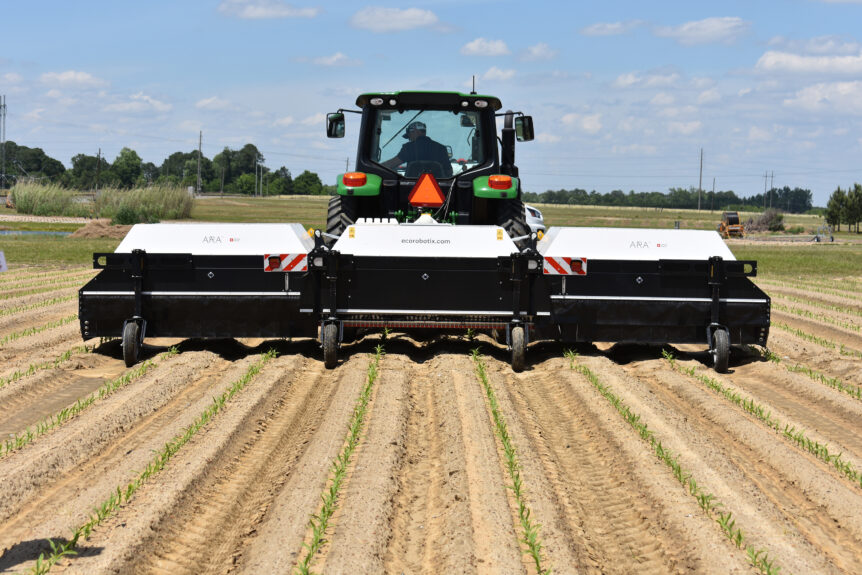
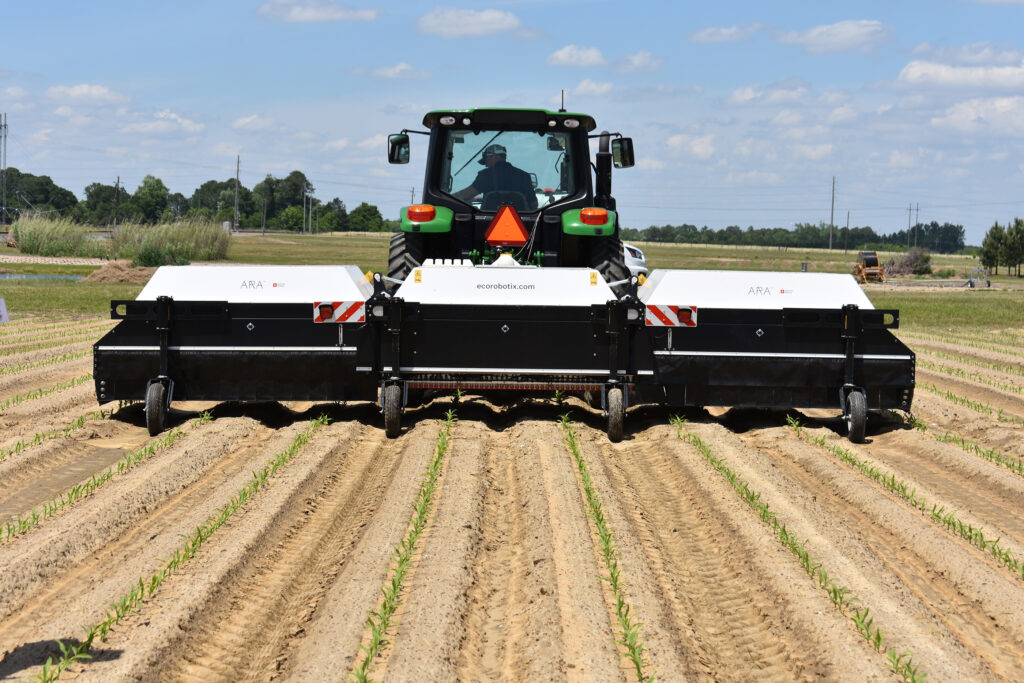
Technological advancements featured at the conference included a solar-powered spot spraying robot; AI mechanical weeders and autonomous multipurpose robots. All were demonstrated during the field portions of the show and were featured as tools to help growers be more efficient. But their high price tags may preclude many growers from experiencing that efficiency.
“There might be costs you don’t even anticipate. This might be, say, a perfect tool or technology for a grower to use, but it doesn’t pair with his tractor. So now he’s going to have to maybe rent a tractor if he wants to be able to use that technology,” Sosnoskie said. “That’s a scenario that we actually had in New York State. We had a grower who wanted to use electrical weeding, and it was working. But he didn’t have a tractor with a big enough engine and enough horsepower to the PTO to power the electrical weeding generator. So, he had to rent a tractor.”
Sosnoskie said researchers like herself need to collaborate with economists to lay out what those expenses look like and what the return on investment (REI) should feasibly be. An REI is a financial metric that assesses an investment’s profitability by comparing its gain or loss in relation to its cost. Growers must determine if specific pieces of equipment equipped with advanced technologies are financially feasible for their particular farming operations.
“You need to develop a realistic ROI based on your farm,” Sosnoskie said. “Understand that a lot of the technology has developed in the western United States. It’s been adopted more quickly in the western United States,” Sosnoskie said. “An organic lettuce grower in California might have a very different ROI than a conventional grower in Southeast Georgia. So, I think that is crucial, is don’t accept what you see from ROIs. You really need to do the numbers for your own farm.”