









Photos by Clint Thompson
By Clint Thompson
Artificial intelligence (AI) continues to enhance the agricultural landscape. How specialty crop producers farm today may look different from how they farm five years from now.
The potential future of specialty crop production in the Southeast was on display during the Southeastern Specialty Crop Technology Conference & Show in Tifton, Georgia, in early May.
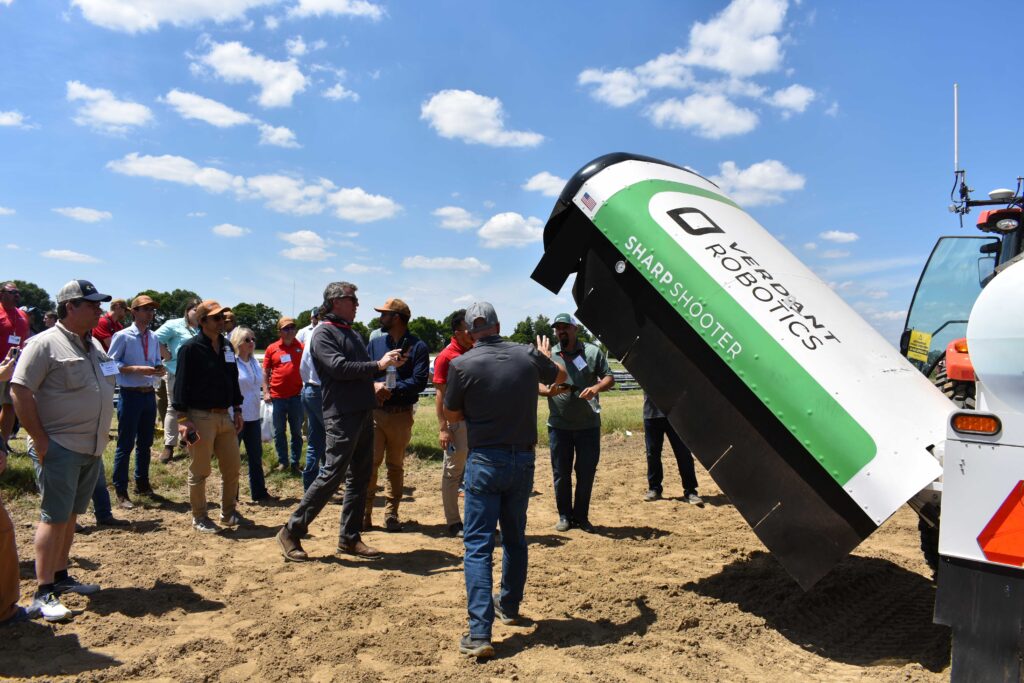
Ag companies and industry leaders flocked to the University of Georgia (UGA) Tifton Campus Conference Center for the two-day event that showcased technological advancements currently available on the market.
Awareness and Adoption
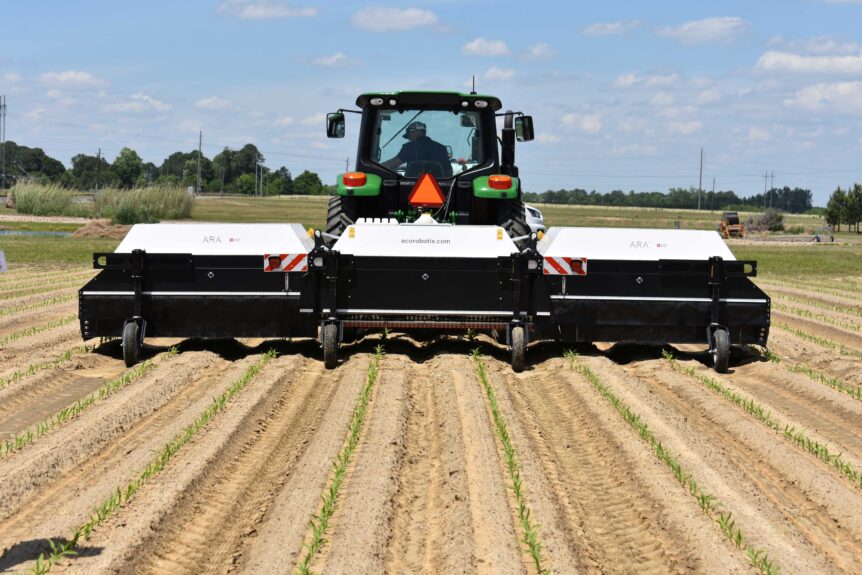
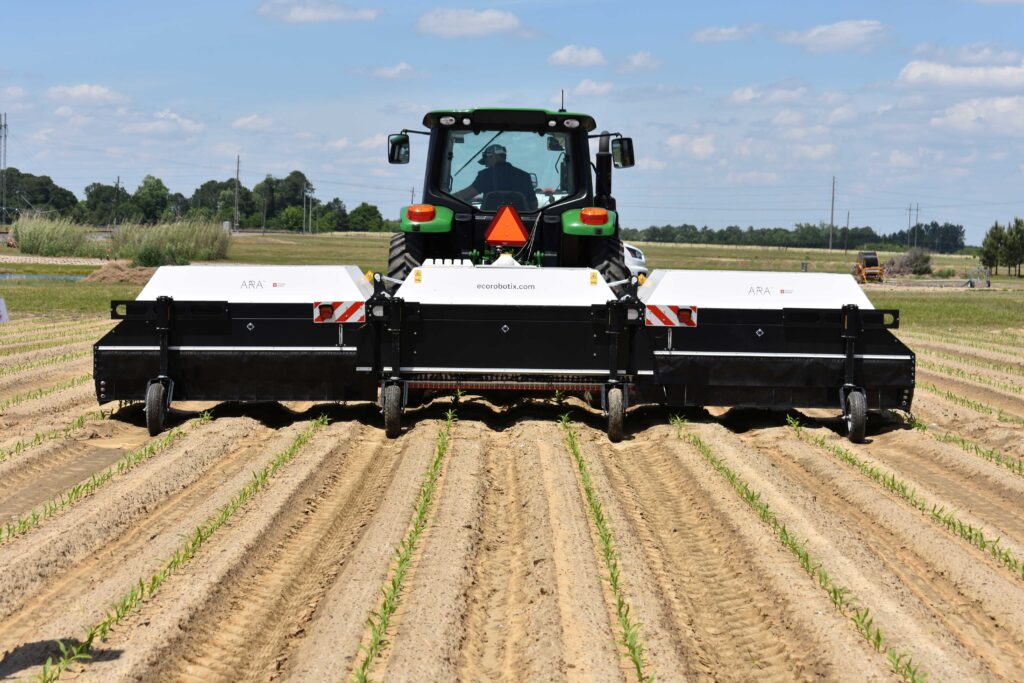
Such advancements included a solar-powered spot-spraying robot, spray drones and autonomous multipurpose robots. All were demonstrated during the field portion of the event. For many in the Southeast, this was their first time seeing these technologies up close, said Luan Oliveira, UGA assistant professor and precision ag Extension specialist.
“What we’re trying to do with this Southeastern Specialty Crop Technology Conference & Show is place growers, researchers, industry and students together in one place to increase awareness and knowledge about the technologies on the market,” said Oliveira, who organized the event.
He explained that a lot of the technologies are built on the West Coast, in places like California or Washington, and take time before they arrive in the Southeast. Oliveira understands the obstacles to adoption in the Southeast and says it will not happen overnight.
“My job as a precision agriculture Extension specialist is to bring new things to the table, test those things and make sure that they are applicable to our reality here in the Southeast,” said Oliveira. “So another reason we’re hosting the conference is to introduce concepts, and sometimes those concepts are ready to be applied here, and we just didn’t know about them.
“We’re not going to generate adoption right away, but we’re going to generate questions from growers, such as ‘I don’t plant the same way you plant in California, so how can your product be adapted to my operation?’”
Consider Costs
The main factor that will negatively influence a quick adoption rate throughout the region are the costs. Growers are already faced with historically high input expenses. Labor costs are high, and market prices for crops are low. Most view their farming operations through a year-by-year prism and not too far into the future.
“Right now, a lot of these technologies come with huge price tags for just the cost of purchasing the equipment,” said Lynn Sosnoskie, assistant professor with Cornell University, who presented at the conference. “But there’s other costs that come with it as well. There are subscription fees. There are maintenance costs and other operational costs, and there might be costs you don’t even anticipate. This might be a perfect tool or technology for a grower to use, but it doesn’t pair with his tractor. So now he’s going to have to rent a tractor if he wants to be able to use that technology.
“That’s a scenario that happened in New York. We had a grower who wanted to use electrical weeding, and it was working. But he didn’t have a tractor with a big enough engine and enough horsepower to power the electrical weeding generator. So, he had to rent a tractor.”
Sosnoskie said researchers like herself need to collaborate with economists to lay out what those expenses look like and what the return on investment (ROI) should be. An ROI is a financial metric that assesses an investment’s profitability by comparing its gain or loss in relation to its cost. Growers must determine if specific pieces of equipment with advanced technologies are financially feasible for their particular farming operations.
ROI
Sosnoskie recommends growers test ROI first. If the price point and technology are actually suitable for the operation, growers will more likely be successful in getting their money back.
Not a Fixall
As promising as some of the advanced technologies are, the future of ag production is still likely to include current management tactics already in place. University researchers emphasized that message during the conference.
Instead of depending just on herbicide sprays and workers walking through the fields and hand-weeding, mechanical weeders are available that can pull the weeds themselves.
However, UGA Extension weed scientist Stanley Culpepper cautioned that advanced technologies won’t do all the work. For example, herbicide programs and laborers will still be needed to eliminate the vast majority of weeds, but new tools could be used to clean up the remainder.
Despite the challenges, there is general excitement in the ag community about what can help growers be more efficient and sustainable in their farming practices.
Click here to view video about the conference.