









By Tacy Callies, Clint Thompson and Frank Giles
The Citrus & Specialty Crop Expo provided vital information to steer growers to long-term sustainability. After a brief stint in Tampa, the annual event returned home to Fort Myers, Florida, its original location.
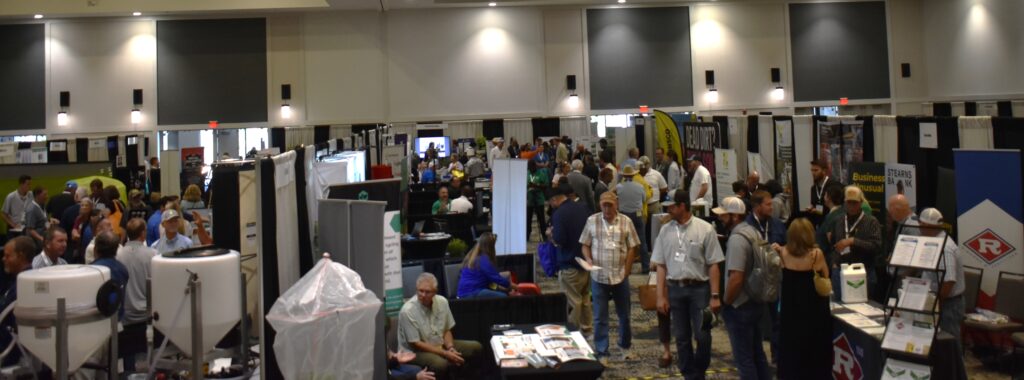
Citrus and specialty crop growers, along with vendors and industry specialists, convened Aug. 12–13 at the Caloosa Sound Convention Center and Luminary Hotel in Fort Myers. The new Expo venue was welcomed for its convenience and amenities.
Meg Wally, sales and inventory coordinator with Tree Defender, has attended the Expo for the past six years. She appreciated the event returning to Southwest Florida.
“It’s great to be back home. We are seeing a lot of our friends that we haven’t seen in a long time. We’re spending more time with those friends and those growers. The venue is beautiful; the food is fabulous. Everybody is having a really good time,” Wally said from her booth on the trade show floor.
A Land Remembered
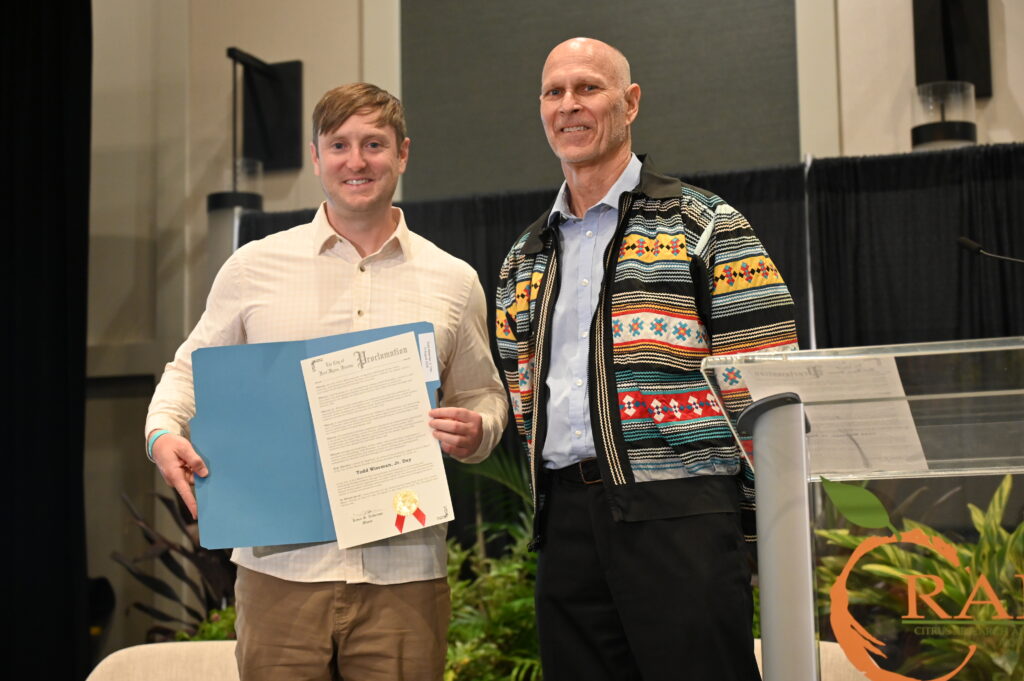
A highlight of the event’s general session was a presentation by Todd Wiseman Jr., who is creating a TV series based on the historical novel A Land Remembered. The novel is a favorite of Florida’s agricultural community.
Wiseman showed a trailer for the first season during his presentation, which was very well received by attendees. He will be shopping the series with streaming services soon.
Citrus Education
The citrus education seminars covered a wide range of topics over the course of two days. A panel discussion on oxytetracycline (OTC) featured Ute Albrecht, University of Florida Institute of Food and Agricultural Sciences (UF/IFAS) associate professor, and citrus growers Jim Snively and Larry Black. The discussion, moderated by AgNet Media’s Frank Giles, covered Albrecht’s research program and how OTC treatments have improved tree health, quality and yields in both growers’ groves.
“Right now, I don’t know that my groves have ever looked as good as they do now,” Snively said. “And that includes before HLB came along.”
Stay tuned for a more in-depth article on the OTC panel in a future issue of Specialty Crop Grower.
The Wednesday afternoon citrus seminar included presentations from UF/IFAS researchers on improving tree health. Lukasz Stelinski discussed combining tools to manage pests. One such strategy is to combine OTC injection with the use of gibberellic acid. He pointed out that OTC does not cure trees; it reduces HLB pathogen load. Studies show more than 99% of OTC is gone 45 to 60 days after application, but an added benefit of the treatment is fewer psyllids infected with HLB.
Yiannis Ampatzidis presented research on artificial intelligence tools. He said integrating aerial, ground and machine-based sensing creates a more complete picture of grove variability and supports more targeted management.
A talk on soil health by Sarah Strauss concluded that increasing soil microbes is a viable strategy to manage HLB-affected trees with minimal risk. But she warned it takes time for changes in microbes to translate into changes in trees.
Tripti Vashisth detailed her research on biochar and compost, which shows using the two tools in tandem yields the best results. Biochar improves photosynthesis and water retention while reducing nutrient loss and drought stress. Other biochar benefits are higher fruit set and bigger fruit size.
Thursday’s citrus seminars kicked off with talks on fresh fruit. Tina Charpentier of the Padilla Agency discussed promotions from the Florida Department of Citrus. Marketing efforts center on building greater visibility, availability and demand.
Arnold Schumann spoke about citrus under protective screen (CUPS). He detailed how the CUPS microclimate benefits citrus and said the Minneola tangelo has high potential value under screen.
Lauren Diepenbrock covered pests in CUPS, noting that lebbeck mealybug and chilli thrips are the most economically important ones. Megan Dewdney centered her talk on two long-time diseases in Florida-grown fresh fruit: Alternaria brown spot and citrus scab.
Specialty Crop Education
Specialty crop seminars were also a part of the Expo. Speakers discussed various topics impacting production, including management of Thrips parvispinus and nematodes in vegetables, plasticulture optimization and food-safety considerations.
UF/IFAS researchers Jawwad Qureshi and Hugh Smith highlighted biopesticides as a way to treat two of the most significant insect pests (whiteflies and pepper weevils) in Florida vegetables. Biopesticides help offset the increasing resistance to conventional insecticides but should be used within an integrated pest management program.
UF/IFAS weed scientist Ramdas Kanissery discussed nutsedge, the one weed that can pierce through plastic in vegetable beds. He highlighted what management options work in Florida plasticulture. This includes fumigation and pre-emergent herbicides. A combination of the two provides more consistent control.
One of the main crops produced in plasticulture is bell pepper. Tara Wade, UF/IFAS agricultural resource economist, updated growers and industry specialists about how demand for bell peppers remains high with domestic availability having increased by 150% since 1990. However, imports have increased by 66% from 2010 to 2024.
The second part of the plasticulture session focused on thrips, whitefly-transmitted tomato viruses and fungicide research for management of powdery mildew. Amanda McVay, a UF/IFAS graduate student, said that fungicide sensitivity varies across Florida, highlighting the need for localized disease monitoring.
An important part of specialty crop production is food safety, especially amid the recent Cyclospora outbreak that has impacted lettuce. Rory Wang, a postdoctoral associate at UF/IFAS, focused on the disease and what measures growers can take to mitigate its impact. This includes practicing proper hygiene and keeping sick workers away from fruits and vegetables in the field.
Video Component
Click here to view video.