









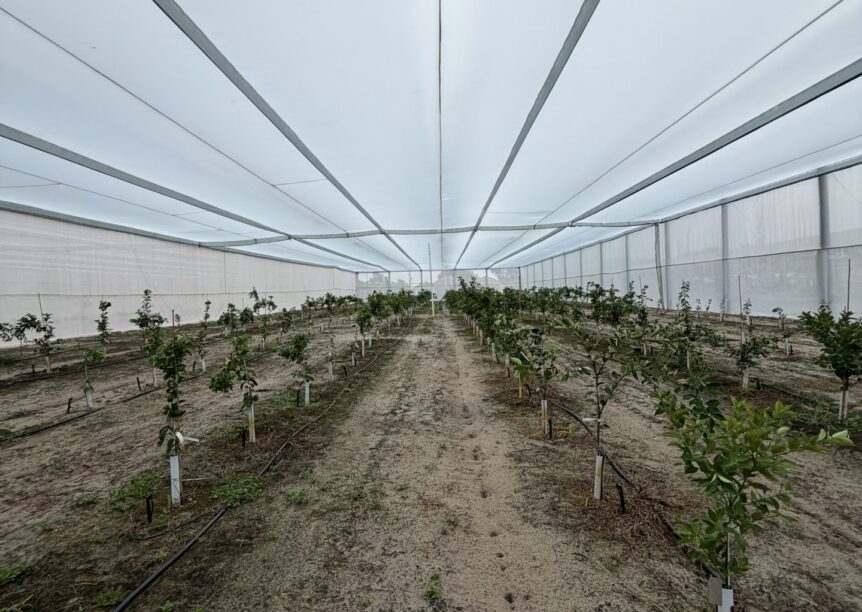
Citrus under protective screen (CUPS) has proven its effectiveness in helping Florida citrus producers overcome citrus greening disease. Its place in the cold-hardy citrus region remains a question, however.
Arnold Schumann, professor at the University of Florida Institute of Food and Agricultural Sciences (UF/IFAS) Citrus Research and Education Center and leading CUPS researcher, discussed the potential for CUPS in the cold-hardy region during a field day at the UF/IFAS North Florida Research and Education Center on Oct. 1.
“I have some concerns; for example, snow that we do not get in Central Florida. Snow could be a devastating thing,” Schumann said. “You’ve got to think about that. I do not believe that 50 or 40 mesh screen on the roof will permit snow to go through. It barely lets water through. So, snow will accumulate and cause problems.”
The primary purpose of CUPS is to protect the crop against the Asian citrus psyllid, the vector of citrus greening disease. Reports of the psyllid have been minimal in the cold-hardy region so far. That is likely not always going to be the case, however, according to Schumann.
“If that’s your primary concern, I would wait until the enemy, being the psyllid, is truly a problem, because it is so much more expensive to grow citrus in CUPS. I don’t think there is a justification if there’s really no psyllid pressure yet,” Schumann said. “But I think it’s coming because the climate’s changing. It’s considerably warmer. I’ve tracked the weather. It has been a doubling or more of hot days and nights. The nights don’t cool down, and that’s conducive to psyllids. It’s a warm-weather insect. Expect more psyllid encroachment into these regions that historically have been free of psyllids. But I would wait until it becomes a real challenge and then spend the money on the CUPS.”

By Clint Thompson