









By Clint Thompson
Current dry conditions in the Southeast region are expected to stay that way for the next couple of months. This is according to Pam Knox, University of Georgia (UGA) Extension agricultural climatologist. She noted in the UGA Climate Blog that the NOAA Climate Prediction Center forecasts drier than normal conditions, especially in Georgia, Alabama and the Florida Panhandle.
The drought’s continuation should continue during the February-through-April timeframe.
“Things could look quite different by the end of April, but at least for right now, we don’t see any big changes towards a wetter pattern,” Knox said. “It takes a while to come out of a drought. Even if we go into a wetter pattern, it’s still going to take a while for the soil moisture to really get moist again.”
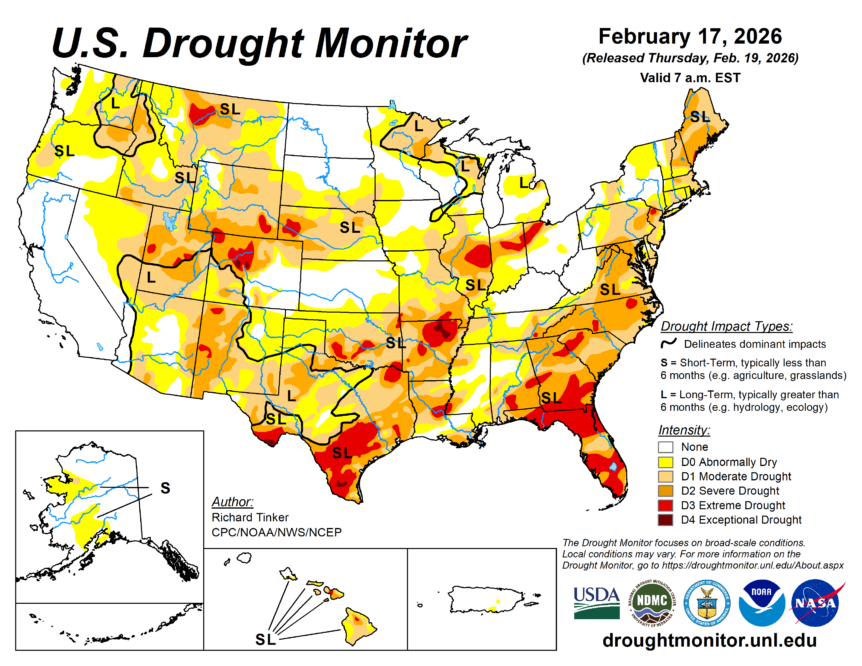
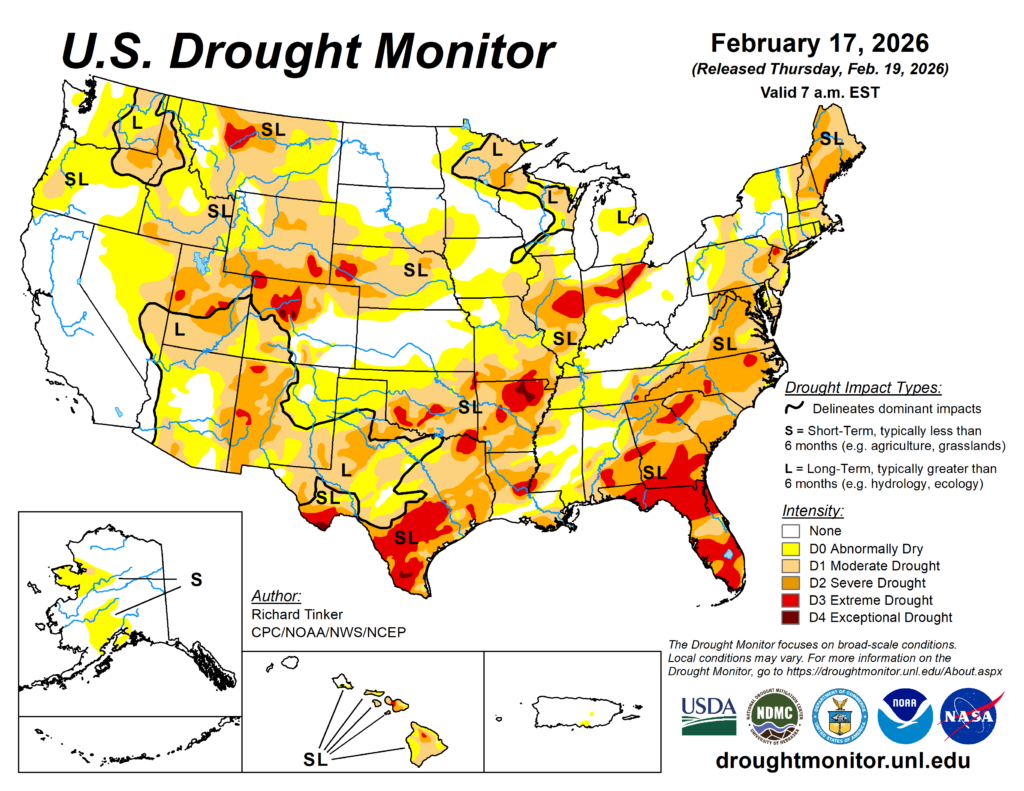
The dry conditions remain prevalent throughout the Southeast, according to the Feb. 19 release of the U.S. Drought Monitor. The Southeast region continues to observe expansion of extreme drought throughout North Florida and South Florida, along with South Georgia.
Extreme conditions in South Georgia start in the southwest corner of the state in Seminole and Early counties; stretches eastward to Ware and Charlton counties and northeastward to Bryan and Chatham counties; and northward to Laurens, Johnson and Emanuel counties.
A separate area in west Georgia is observing extreme drought conditions as well. It is located in all or parts of Chattahoochee, Muscogee, Harris, Talbot, Marion, Taylor, Crawford, Monroe, Meriwether and Upson counties. Another extreme drought area is located in the northeast part of the state, including all or parts of Lincoln, Wilkes, Oglethorpe, Oconee, Clarke, Walton, Barrow, Jackson, Madison, Elbert and Hart counties.
A couple of areas in Alabama are observing extreme drought conditions. One is located in the southern part of the state, including Covington, Escambia, Conecuh, Monroe, Wilcox and Butler counties. The other with extreme drought is observed in the southeastern part of the state, including Bullock, Macon, Russell and Lee counties. The southeastern part of the state includes mostly severe drought conditions.
Southwest Alabama has moderate drought conditions, as does most of North Alabama and along the Alabama-Georgia state line. Abnormal drought conditions are seen in central Alabama and other areas in northern Alabama.