









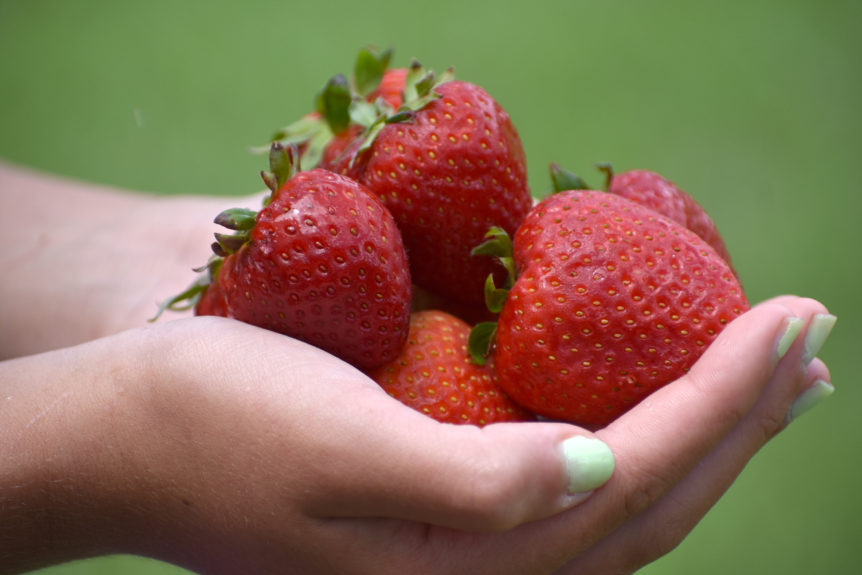
Florida’s late fall and winter do not just bring cooler, less humid weather; they bring the sweet burst of locally grown strawberries. Juicy, vibrant and fresh from the fields, these Sunshine State gems are waiting at your favorite market.
Farmers in Hillsborough, Manatee and Polk counties are growing and harvesting Florida strawberries on about 16,000 acres from December until the end of March – an industry approaching $500 million a year across the state.
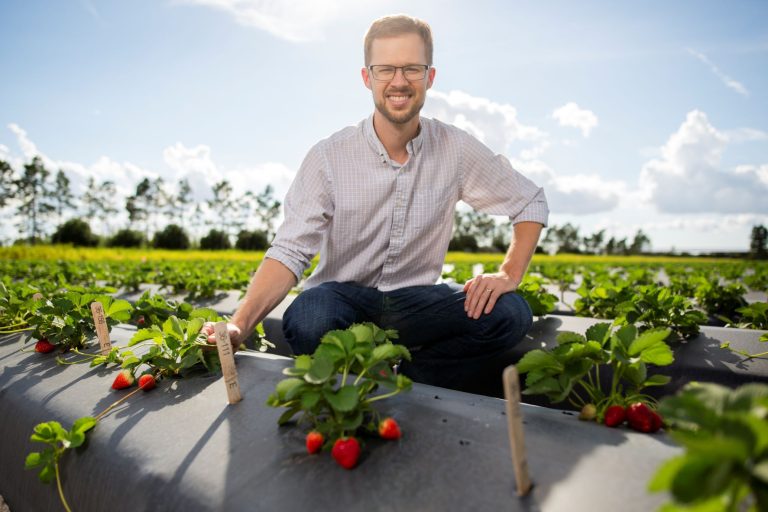
Vance Whitaker, a strawberry breeder at the University of Florida Institute of Food and Agricultural Sciences (UF/IFAS), said growers planted from about Sept. 25 to Oct. 20. Fruit is now starting to be harvested, and there should be plenty on the market.
About 88% of strawberry varieties grown in Florida were developed by University of Florida Institute of Food and Agricultural Sciences (UF/IFAS) researchers.
Ember and Encore
Just last season, Ember™ and Encore™, both varieties from Whitaker’s lab, were commercialized. Ember™ (8%) and Encore™ (5%) accounted for about 13% of the acreage planted.
This year, Ember™ (35%) and Encore™ (18%) acreage has increased about 400% — comprising about 53% of the farmland on which strawberries are grown, said Whitaker, a professor of horticultural sciences at the UF/IFAS Gulf Coast Research and Education Center and strawberry breeder.
“They (Ember™ and Encore™) have robust plants, which help produce high early yields in November and December and excellent overall flavor and shelf life,” Whitaker said. “They also have better overall disease resistance than previous varieties, making them more sustainable to grow for our farmers.”
‘Florida Brilliance’ is the next more popular variety for farmers, growing on about 27% of acreage.
The UF/IFAS strawberry breeding program has existed since 1948 and has produced dozens of cultivars. Those varieties are grown on all continents, except Antarctica.
That success means Whitaker brings farmers and consumers what they want.
“The appearance of the fruit on the grocery store display is key, particular a vibrant red color and uniform shape,” he said. “However, the eating experience is the most important. Good texture and a sweet but slightly tangy flavor are extremely important.”
Pineberry
About five years ago, Whitaker developed a novel strawberry, called the ‘Pineberry.’
It’s mostly white, rather than the usual red, and smells a little like a pineapple. Pineberry grows on about 325 acres.
“The pineberries will be present once again this winter in stores carrying Florida strawberries,” he said. “But they are still a niche product, as many people are still not familiar with them.”