









By Clint Thompson
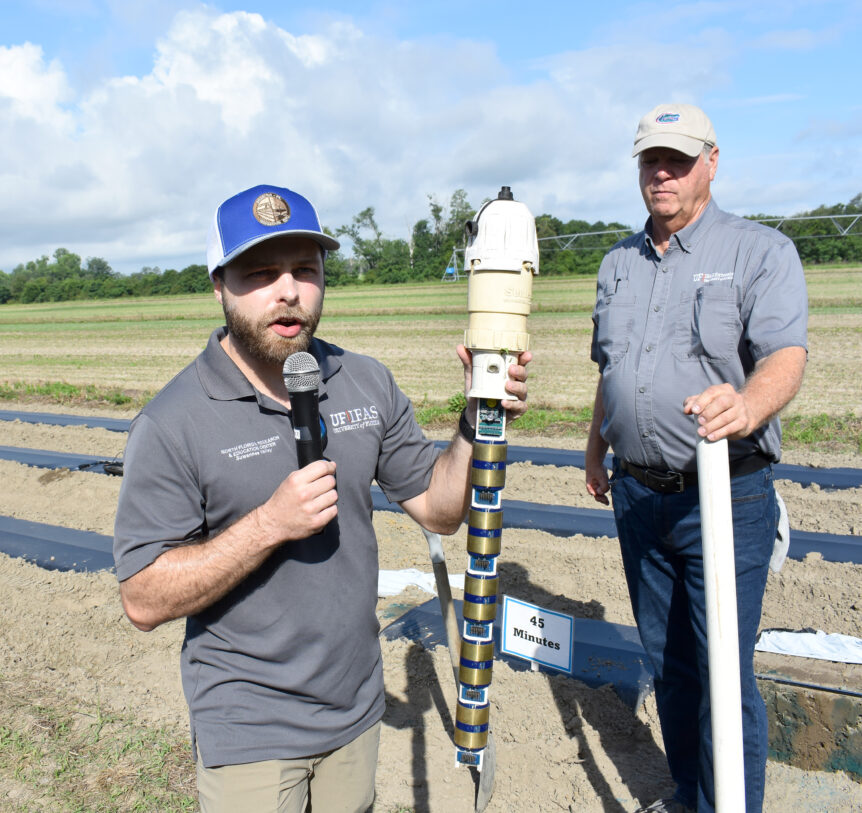
Soil moisture sensors are used by most large-acre farmers in Florida, according to one industry expert. Extension personnel can help growers use the technology more effectively, says Jay Capasso, University of Florida Institute of Food and Agricultural Sciences (UF/IFAS) Water Resources Regional Specialized Agent for Northeast District
Capasso was a featured speaker during the recent Georgia-Florida Irrigation Expo on June 10. He highlighted the value that sensors provide.
“I’d say the bigger growers in Florida, most of them have them. There’s a lot of big watermelon growers that we work with, they pretty much all have them. We’ve got cost share down there, so they’re getting something like 80% to 90% cost share back on the soil moisture sensors,” Capasso said. “Let’s say you purchase a $2,000 soil moisture sensor, you’re going to get something like $1,800 back.
“I think the struggle is just to make sure everybody knows what they’re looking at and learn how to read the lines and everything.”
Soil moisture sensors help producers better understand when additional irrigation is needed. Growers can avoid applying too much water simply by utilizing real-time technology that shows what moisture is in the soil.
Extension Help
Capasso recommends that growers, especially those that are new to implementing soil moisture sensors, meet with an Extension agent, consultant; someone that is used to looking at sensors.
“They’re going to teach you how to read the lines. Sometimes growers are just looking at the dashboard or the summary line of all the sensors together, seeing whether it’s in the red or the green or the blue or different dashboards that these companies have,” Capasso said. “What I’m really trying to do is teach growers to read the individual lines. Whether what the line at 18 inches looks like, what it looks like at six inches, what it looks like at 24 inches, I want them to do that over time and think about it that way.
“Over time, you can kind of tell, if you’ve got much higher salts down at 24 inches well below your root zone, that’s telling you something. You’re probably, getting too much, or maybe there’s big rainfall at that. We can’t control everything. But I think it’s very helpful over time once you learn how to read the lines. And you’ve got extension here at UGA in Georgia, UGA Cooperative Extension, and you’ve got Florida, University of Florida, and the other land grants Fort Valley State, we can help you out.
“Once they look at it over time and they use it, they’ll begin to trust it more and more.”