









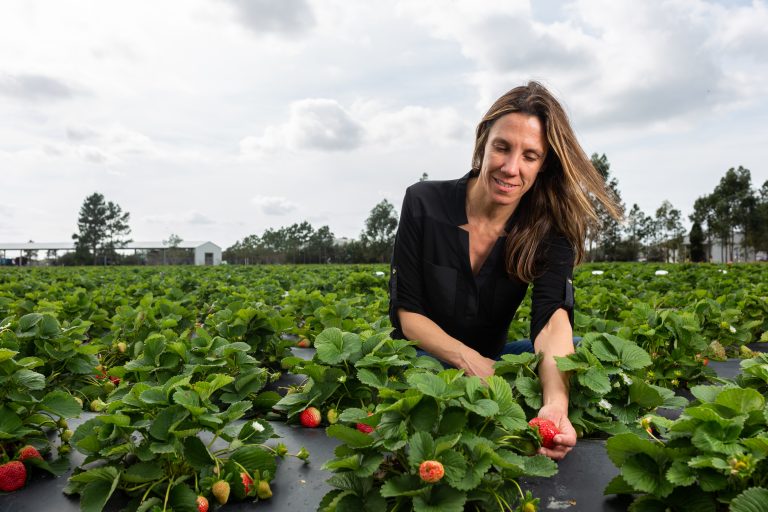
Strawberry growers across the country aren’t just tending fields – they’re often running a quiet race against fast-moving plant diseases. When trouble strikes, their first call is often to the plant pathologists at the Gulf Coast Research and Education Center (GCREC).
The latest culprit has entered the scene in the form of Fusarium wilt disease, which is popping up along the East Coast.
Fusarium wilt can survive in soil for years and spread through infected plant material and equipment, said Natalia Peres, University of Florida Institute of Food and Agricultural Sciences (UF/IFAS) professor of plant pathology at GCREC. Current strawberry varieties show limited resistance to the disease, and there are few effective fungicides, making the disease especially difficult to control.
Peres and Marcus Marin recently discovered the disease in Florida, North Carolina, New York, Connecticut and Virginia.
Gulf Coast Research and Education Center
Strawberry farmers from 22 states send their samples to the lab in Balm (in Hillsborough County), Marin said. They know they can count on the expertise and technology at GCREC.
“Because our program is largely focused on strawberries, we have been able to develop and implement molecular methods that allow for rapid diagnosis,” said Marin, an assistant professor of plant pathology at GCREC. “That way, we can provide preliminary results to growers within 24 to 48 hours after receiving a sample, while it would normally take seven to 10 days, using traditional methods.
“When sick plants arrive at our clinic, we first look for the parts that seem sick. Then we test those plant pieces in the lab to find out what is making the plant sick.”
Peres likens the clinic to “an X-ray of what is going on in growers’ fields.”
“I would say it pretty much helps us guide the priorities of our research program,” Peres said. “Every season is different, and we never know what diseases to expect, so we have worked on them all, from Botrytis to anthracnose, crown rots, Neopestalotiopsis and now the threat of Fusarium wilt.”
Marin, a former doctoral student and post-doctoral researcher under Peres’ supervision, said he has worked on developing diagnostic tools for Neopestalotiopsis.
Statewide Diagnostic Labs
The clinic at GCREC is among the five diagnostic labs of UF/IFAS Extension serving different regions of the state. The main clinic is in Gainesville, but plant pathologists statewide help growers of many crops find out what’s ailing their produce. In addition to Gainesville and GCREC, other clinics are at the North Florida Research and Education Center (NFREC), Southwest Florida Research and Education Center (SWFREC) and the Tropical Research and Education Center (TREC).
“UF/IFAS plant diagnostic labs are considered among of the best, globally, due to the high level of expertise in diagnosing hundreds of plant pathogenic fungi, bacteria and viruses,” said Mathews Paret, chair of the plant pathology department. “When coupled with expertise in predictive tools (e.g. the Strawberry Advisory System developed at GCREC) and rigorous field-testing of new approaches, this provides the much-needed knowledge supporting Florida and U.S. agriculture.”