









By Clint Thompson
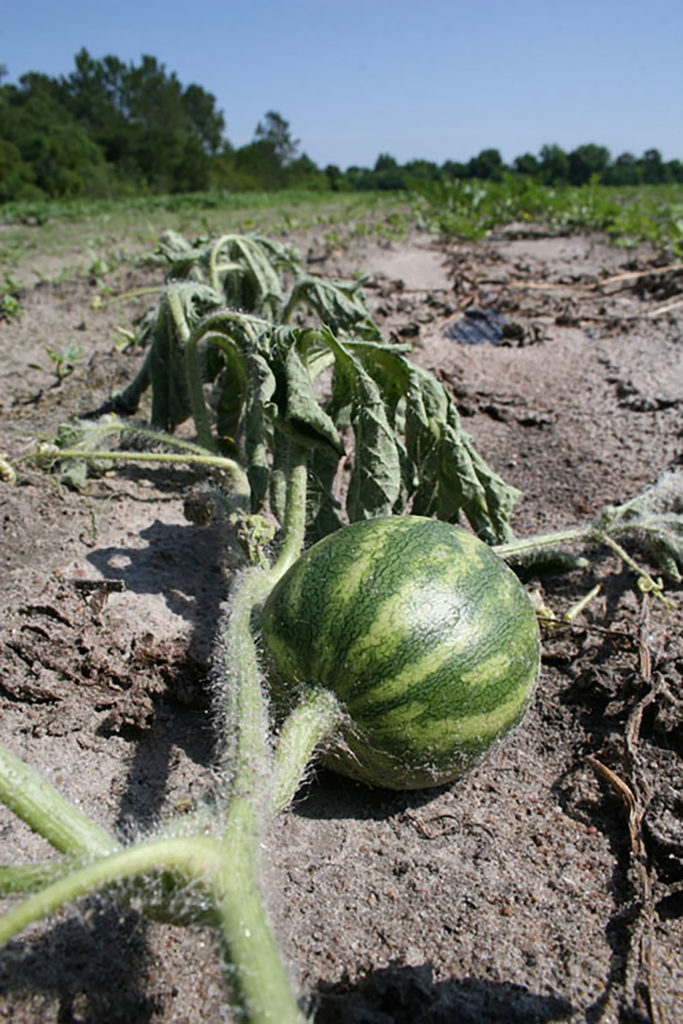
North Florida and South Georgia watermelon producers must be aware that fusarium wilt disease is showing up across North Florida.
Bob Hochmuth, University of Florida Institute of Food and Agricultural Sciences (UF/IFAS) Regional Specialized Extension agent in Live Oak, Florida, said in his weekly email that the disease has also been observed in UF/IFAS research trials. Symptoms include yellowing and wilting of leaves; vine decline and necrosis; vascular discoloration; and patchy plant death across the field.
“This is the time of the growing season where we typically begin to see the plant collapse. That plant collapse comes with the early onset of fruit set,” Hochmuth said.
“When the plants are young and only vines, if they’ve got a partially clogged water conducting vessel system, they still might be able to pick enough water to get through to manage, but when they start getting fruit set, the plants demand a lot more water suddenly.

“What it does is the capacity of the water conducting vessels is just insufficient to get the water that’s needed to the rest of the plant. That’s when you see the sudden collapse. Even though the fusarium is there working on clogging the water conducting vessels for a while, it finally succumbs to that extra load on the plant.
“If you’re needing a lot of water for this young fruit set, it overcomes the ability of the plant.”
Limited In-Season Options
Unfortunately, in-season management remains limited. Options like Proline have produced inconsistent results across various locations and environments. If plants have started to collapse, chemical applications are unlikely to recover yield, but they may protect from further infections.
“The reality is the infection, the activity actually started back weeks ago. We’re at a point now where the difference in what the plant can pick up and what it needs, we’ll see certain fields that’ll continue to see problems the rest of the season,” Hochmuth said.
The fusarium wilt pathogen is more problematic in early planted watermelons, mostly due to temperature favorability. Soil temperatures in March and April usually stay below 86 degrees which favors pathogen activity.
What Growers Should Do Now
- Document affected areas
- Avoid overinvesting in rescue treatments
- Maintain overall crop health where possible