









By Clint Thompson
North Florida watermelon plantings have commenced in the Suwanee Valley.
Water is a key resource in helping the plants grow over the next couple of months. Rain would be beneficial. Not much is expected, however, in the near future, explains Bob Hochmuth, University of Florida Institute of Food and Agricultural Sciences (UF/IFAS) Regional Specialized Extension agent in Live Oak, Florida.
“The concern is we’re already dry. We’re going into the driest months of the year; March, April and early May. The concern is we need rainfall to replenish or hold us, so we don’t get into instances where we have trouble with lack of water from the pumping situation. That would be the greatest concern,” Hochmuth said.
Drought Monitor
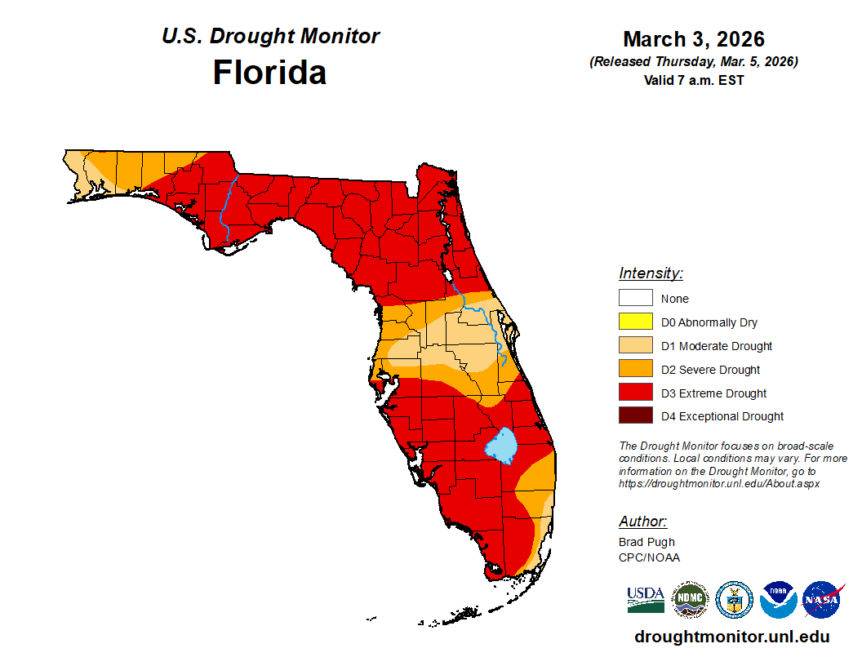
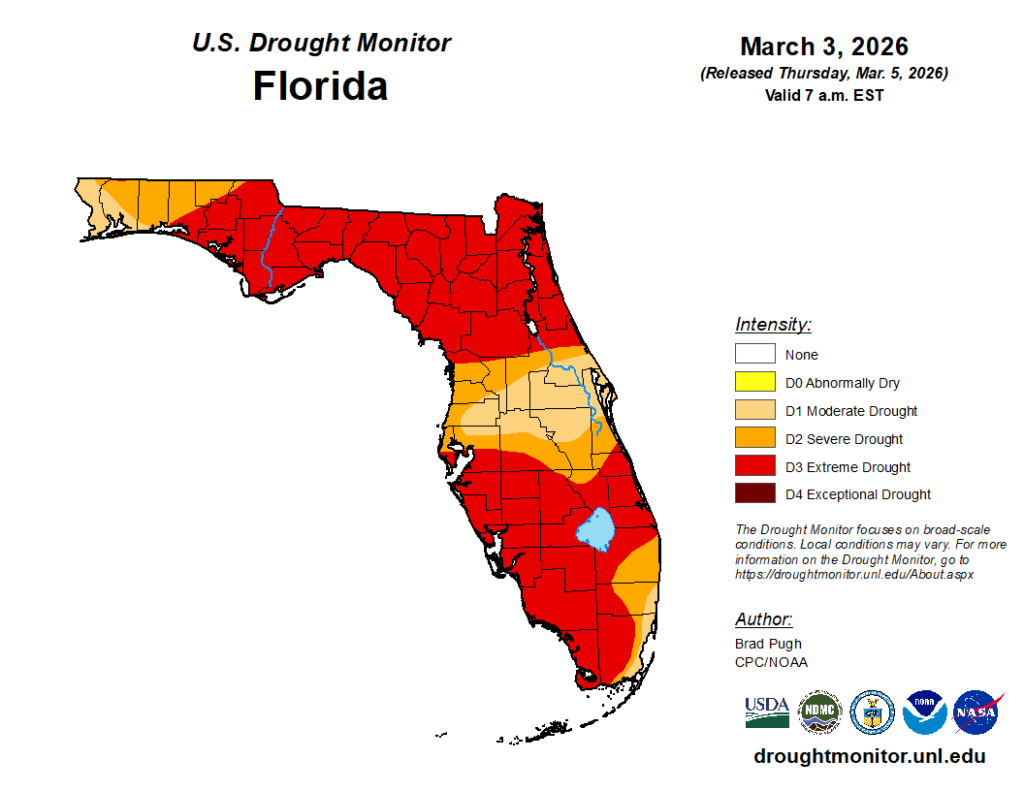
The lack of rain in the region is magnified in the recent U.S. Drought Monitor. Extreme drought conditions are observed over most of North Florida, starting in the Panhandle in Walton and Holmes counties; stretching to the east coast in Nassau, Duval, Saint Johns and Flagler counties; and as far south as Citrus and Sumter counties. Those conditions could worsen heading into the dry season.
“The rains that we have had, less than an inch or about an inch were enough to dampen the top foot or so of soil but not enough to really replenish the aquifer yet,” Hochmuth said. “We all are especially concerned because we know that typically these are the dry months coming up. We need an unusual March, April and May to help us.”
Hochmuth’s growers have the advantage of using soil moisture sensors to schedule irrigation applications. Soil moisture sensors help determine if there is enough water is being maintained in the root zone. They will help growers know when to irrigate.
“We’re using technology to our advantage today to make sure we’re making the most efficient use of the water that’s available to us,” Hochmuth said.