









By Clint Thompson
Georgia may be known as the Peach State, but blueberries have proven to be a bountiful and profitable venture for growers willing to take the plunge. But how long will that profitability last, especially amid today’s challenging economic conditions?
Grower Perspectives
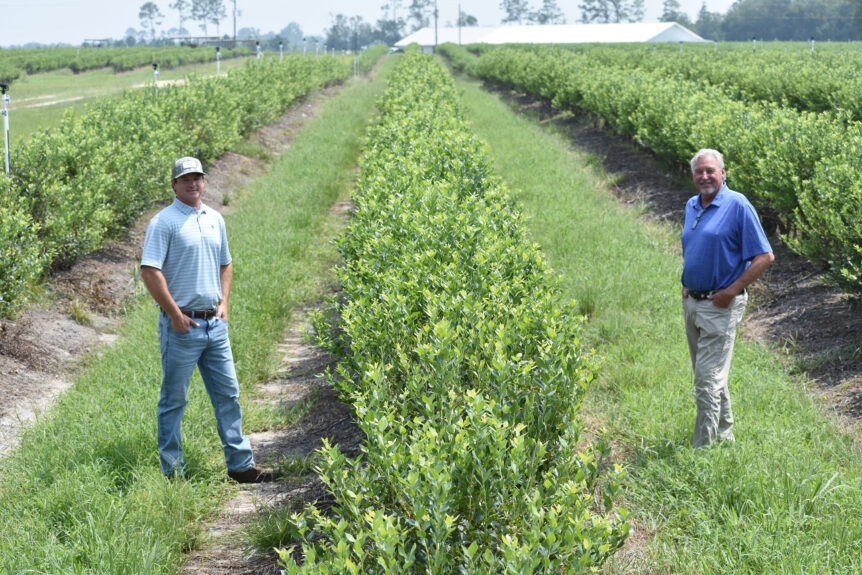
Two Georgia blueberry producers, each with different experiences and paths to the specialty crop sector, discussed the industry and what lies ahead. Each represent different generations of growers who came into the industry at different times.
Hunter Williams grew up in a farming family in Southeast Georgia. Farming was the career path he always wanted to pursue. But that doesn’t mean the Alma-based grower has never had second thoughts. In the current economic landscape, mired in high input costs and low market prices, it is difficult to remain sustainable long term.
Williams says everything the farm uses has skyrocketed in price since COVID. “That has definitely been a huge challenge,” he says. “And it doesn’t help when you’re out there trying to get something done and the tire blows. That’s another $3,000 you must spend to fix it.”
So how does a farmer persevere when there doesn’t appear to be brighter days ahead, especially when other occupations do not face similar challenges? That’s a hurdle Williams has had to overcome in his 11 years in the blueberry business.
“The grass is always greener on the other side, but at the end of the day, it’s still just grass. You do tend to look at different people that are working in different industries with different jobs,” Williams said. “You see when they go home, they don’t take their jobs home with them. If we have a bad day, we have a hard time going to sleep at night, because we know when we wake up in the morning, we’re going to have to face that problem head on again because we’re farmers.”
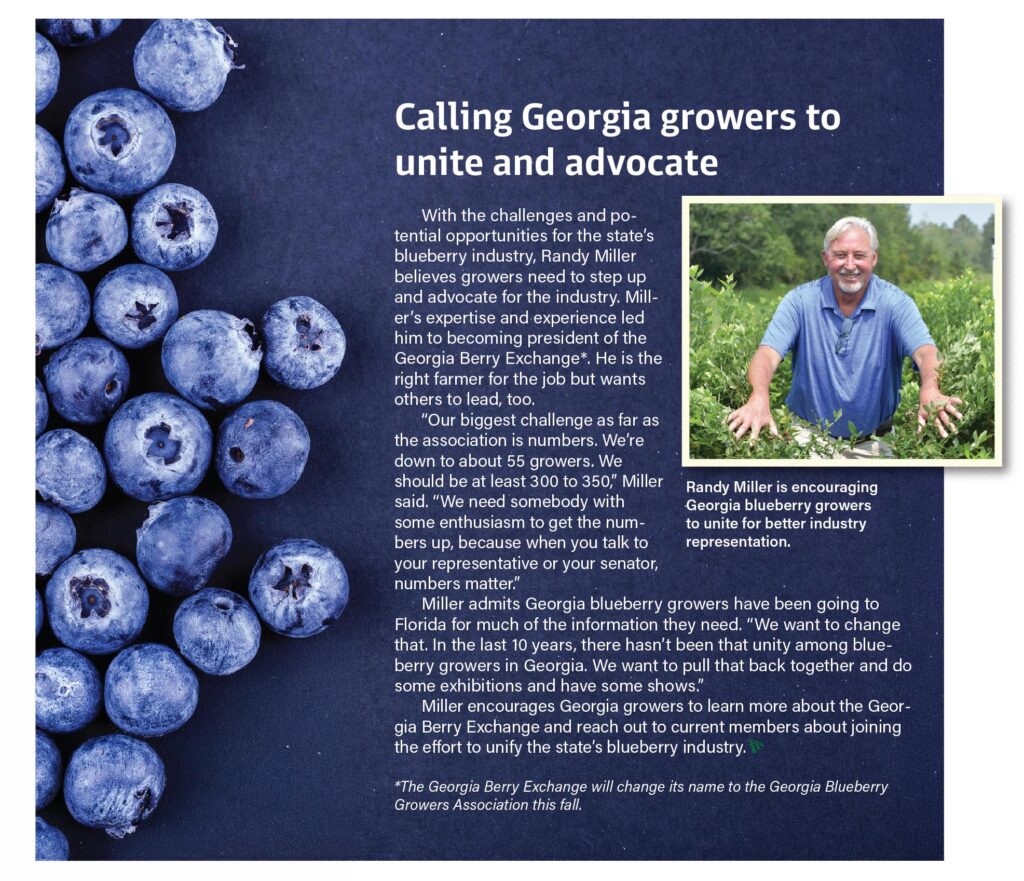
Randy Miller is another large-scale blueberry producer in Bacon County, Georgia. His experience started in 2006 in Nichols, Georgia, a small town with about 3,000 people and one traffic light.
Miller’s career started in the fertilizer business, but his work connections led him to start growing blueberries. What began as a couple of acres around his house, eventually led to 12 and then 200, the number of acres he produces today.
Like other farmers, Miller has persevered through the difficult times but believes Georgia’s blueberry industry is in a good spot. Acreage is where it needs to be. Any additional acres would threaten producers’ abilities to make a worthy profit.
“We’ve probably got all we need in the dirt. But also, a blueberry plant’s life expectancy is around 10 to 12 years. You start seeing a decline in production over time. That helps with keeping that production level at a steady pace,” Miller said.
Miller was part of the “blue wave” in the 2000s when blueberry production spiked in Georgia, leading it to become the top-producing state in the United States. He and others thrived because they knew where their crop was headed after harvest.
“I met a guy getting into the business and I said, ‘The first thing you need to find is a packer and a marketer that will actually take your berries. If that marketer doesn’t take them, and that packer doesn’t want them because a lot of our packing plants are full, you are not in a good spot,’” Miller said.
“One of the guys said, ‘Well, I’ll just build a packing shed.’ I said, ‘Before you spend $2.5 million or $3 million, you better call the marketers and make sure.’ He made those calls and they didn’t want to take anybody else on. I think that’s going to help cap where we are. You can grow all you want, but if you can’t sell it, it’s out of the question.”
Major Impediments
One factor weighing against prolonged sustainability is imports. Blueberries from Mexico continue to flood the United States at a time when Georgia’s crop is hitting the market. Mexico’s infrastructure is strengthened by its government while growers there pay only a fraction of the costs that Miller and Williams must pay for their labor.
“It’s on us to produce a higher-quality product than we get from other countries,” Miller said.
Imports add to a market pushed to the brink at the time that Georgia producers are selling their crop. Miller favors a trade deal that caps what is imported from Mexico.
“If we’re producing 18 million pounds, then we have filled the market. But when you take 5 million pounds and add on top of that 15 or 18, then we are swamped. The market can’t stand it,” Miller said. “If they would take a certain week when our production is predominant and put a cap on how much comes in, that would be great.”
While Williams has about half the experience of Miller, it didn’t take long for Williams to realize the impediments that threaten long-term production. Williams says one of the biggest needs in the blueberry industry is better disease control.
Disease resistance is a growing concern in the blueberry community. It’s especially a problem with anthracnose, one of the main diseases that producers contend with every season.
“There’s a lot of chemicals that were the cat’s meow years ago. Now that we’ve used them so many years and so often, they seem to not do anything at all to what we’re trying to actually combat in the field,” Williams said.
Optimistic Outlook
Despite challenges, both in production and the industry, Miller remains optimistic about the industry’s future. After all, who doesn’t love a blueberry?
“Everybody likes berries,” Miller said. “There’s nothing better to me. Blueberries are the antioxidant fruit. There are a lot of older growers that are getting out, but these guys (like Hunter) are coming on.”
The most effective ways for blueberry producers to remain sustainable is to promote their products while emphasizing Georgia Grown and agriculture’s impact on local economies.
“We affect so many people. We put so much money into the economy,” Miller said. “The strength of our country depends on agriculture. It always has. We must feed ourselves. To be strong, that’s part of it.”