









By Clint Thompson
Horticultural oil applications are an effective way for peach producers to manage San Jose scale. But there are additional options that growers can implement if they do not achieve initial control.
Brett Blaauw, assistant professor at the University of Georgia (UGA) College of Agricultural and Environmental Sciences, outlined those options in the UGA Peach Blog.
He emphasized that combining an insect growth regular like Centaur or Esteem with the oil can improve the scale’s control. Also, growers can combine Venerate with the delayed-dormant oil application, which can help suppress scale numbers compared to just horticultural oil applications.
“If the populations continue to grow, then you can mix in an insecticide. There are several that can really help knock down the populations,” Blaauw said. “There are options if the oil is not working that we can do, but if you really want to keep those populations low, at least starting with two oil applications will help you, hopefully, keep off the scale for a long time.”
Additional Information
For delayed dormant timing, growers should apply dormant horticultural oils at a rate of 1.5% to 2% oil to water.
Blaauw said the insect will complete 3 to 4 generations every year. The time is now for growers to protect the trees. Growers should avoid making a spray that contains sulfur within two weeks of oil applications.
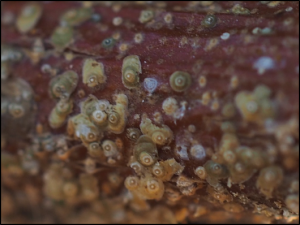
San Jose scale is a tiny insect that has a waxy coating that covers and protects the whole body of the insect. It protects them from the environment and from other insects that would eat them.
For more information and additional management options, please see the peach management guides.
Please note that the 2026 version has now been released online.