Florida is on the verge of a new agricultural crop that could give small farmers in the southern region of the state a high-value alternative to vegetable and fruit production.  University of Florida researchers at the Tropical Research and Education Center have embarked on a comprehensive evaluation of vanilla – from developing fertilizer recommendations to developing the highest-yielding and disease-resistant …
Drought Impact: Northeast Florida Experiencing Dry Conditions
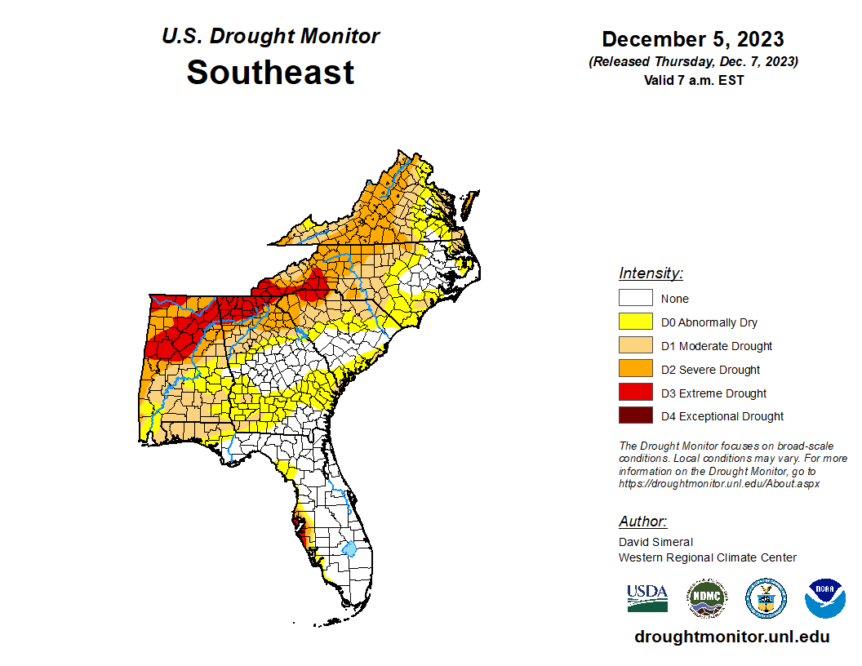
By Clint Thompson The lingering drought has spread across the Southeast and impacted various parts of Florida, specifically in the northeast part of the state. Bob Hochmuth, University of Florida Institute of Food and Agricultural Sciences (UF/IFAS) Regional Specialized Extension agent in Live Oak, Florida, discusses the impact the dry weather is having in his area. “We’re very dry, and …
Back in the Game: China Resurfaces as Purchaser of U.S. Pecans
By Clint Thompson Harvest season is well underway for pecan producers in the Southeast. Growers of pecans are harvesting or are about to harvest the earliest varieties like Pawnee, Elliott, Oconee, Creek and Caddo. Farmers can be encouraged that market prices should not dip below the levels they are currently at. That is due in large part to a familiar …
Pumpkin Popularity: North Georgia Farmer Reflects on Fall Crop
By Clint Thompson An increase in pumpkin acreage has netted Drew Echols income he hadn’t largely counted on prior to 2020. But as demand for the fall-based crop has increased in recent years, so has Echols’ acreage. He produced about 50 acres in 2020, 120 in ’21, 150 in ’22 and has peaked at 175 this season. “I don’t know …
Drought Impact: Northeast Florida Experiencing Dry Conditions
By Clint Thompson The lingering drought has spread across the Southeast and impacted various parts of Florida, specifically in the northeast part of the state. Bob Hochmuth, University of Florida Institute of Food and Agricultural Sciences (UF/IFAS) Regional Specialized Extension agent in Live Oak, Florida, discusses the impact the dry weather is having in his area. “We’re very dry, and …
Thrips Update: Populations Vary in Central, Southern Florida
Thrips pressure is low across central and southern Florida, according to the South Florida Pest and Disease Hotline. Scouts are observing low numbers in pepper in central Florida, with thrips only found in the bloom. Dak Seal, a University of Florida Institute of Food and Agricultural Sciences entomologist at the Tropical Research and Education Center in Homestead, Florida, reports low …
Getting Their House in Order: Farm Bill Legislation on Hold Amid Government Upheaval
By Clint Thompson The waiting game for specialty crop producers eager for new Farm Bill legislation is going to be a longer wait than expected. Kevin McCarthy’s ouster as Speaker of the House a couple of weeks ago means legislators must find his replacement before any progress on a new Farm Bill can take place, says Adam Rabinowitz, Alabama Extension …
$3.2 M USDA Grant: CAES Leads Research to Improve Organic Onion Production
A team of researchers from the University of Georgia (UGA) College of Agricultural and Environmental Sciences (CAES) is partnering with colleagues from Texas A&M University to find more effective production practices for organic onion growers in the southern United States where short-day onions — those that bulb with 11 to 12 hours of sunlight each day — are primarily grown. …
Imports Battering the U.S. Blueberry Industry
By A. Malek Hammami and Zhengfei Guan The United States is a major blueberry producer. The value of production in 2021 reached $1.1 billion, according to the U.S. Department of Agriculture Economic Research Service (USDA ERS). USDA statistics show that total U.S. blueberry production in 2022 was 622 million pounds. The Pacific Northwest states of Oregon and Washington lead in …
Peach Producers Beware: Disease Spray Applications a Must Next Year
By Clint Thompson The lack of fungicide applications for peach diseases last season means growers should be mindful of sprays heading into next spring. Once the freeze events in March wiped out most of Georgia’s crop, it also stopped many producers from applying their normal fungicide sprays. But they should be ready to combat potential disease buildup next spring, according …