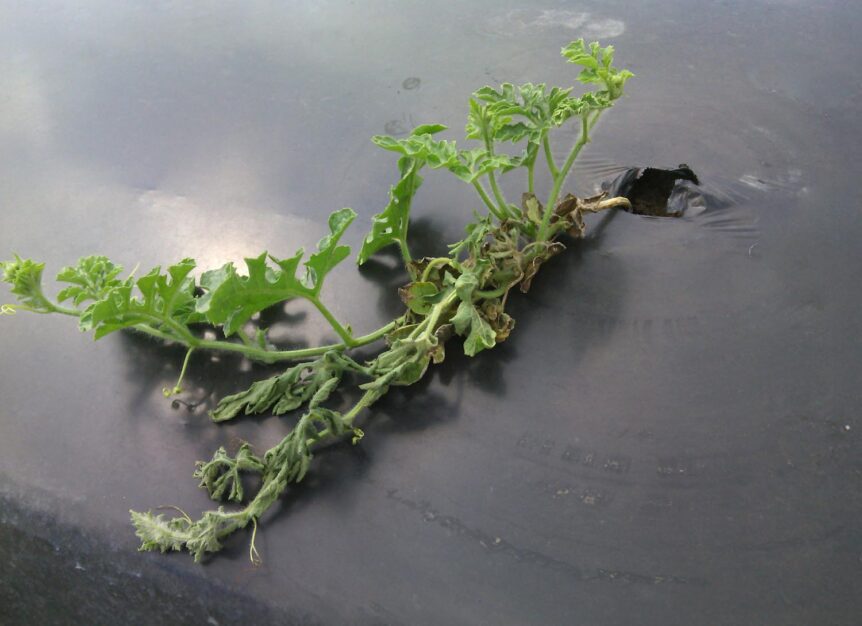
By Clint Thompson Southeast watermelon producers who are pondering the use of grafted plants to combat fusarium wilt disease must remember that grafted plants have later maturity than regular plants. That’s a message that a panel, including Josh Freeman, regional sales manager with TriEst Ag Group, shared at the recent Suwanee Valley Watermelon Institute in Fanning Springs, Florida. “Nobody knows …
Cost Reduction Key in Watermelon Production
By Clint Thompson Cost reduction is near the top of watermelon farmers’ priority lists heading into the 2026 season. It was the subject of a presentation at the recent Suwanee Valley Watermelon Institute in Fanning Springs, Florida. Bob Hochmuth, University of Florida Institute of Food and Agricultural Sciences (UF/IFAS) Regional Specialized Extension agent in Live Oak, Florida, was one of …
Grafted Watermelon Plants a Costly Solution Against Fusarium Wilt
By Clint Thompson Grafted plants provide watermelon growers a costly solution in their fight against fusarium wilt. Josh Freeman, regional sales manager with TriEst Ag Group, estimates the added costs to double what a normal watermelon plant would be. While the added expense is not ideal, it provides farmers a guaranteed solution in their fight against the annual plant disease. …
Short Harvest Window for North Florida Watermelon Growers
By Clint Thompson The harvest/marketing window for North Florida’s watermelon crop is not open for very long. That is why it is imperative that growers in the Suwanee Valley maximize their crop potential every year. They plant early and harvest the crop before the watermelon industry moves north to Georgia. It is the same scenario for watermelon-producing states up and …
Acreage, Fusarium Wilt on Minds of North Florida Watermelon Growers
By Clint Thompson North Florida watermelon farmers are on the cusp of another planting season. They are currently planning for next year’s crop. Part of that planning stage was attending the recent Suwanee Valley Watermelon Institute. Mark Warren, University of Florida Institute of Food and Agricultural Sciences (UF/IFAS) Extension agent in Levy County, helped organize the event this year in …
Early Watermelon Plantings the Norm in North Florida
By Clint Thompson As soon as North Florida watermelon producers can get their plants in the ground, the sooner they can harvest their crop amid a tight marketing window. So, it has been no surprise to see so many farmers start their planting seasons earlier and earlier in recent years. But that has been the case and will likely happen again …
Suwanee Valley Watermelon Institute Panel Highlights Grafting’s Importance During Fusarium Wilt Discussion
By Clint Thompson Fusarium wilt remains a challenge for watermelon producers in North Florida and South Georgia. Grafting is a way for growers to navigate its challenge, says Josh Freeman, regional sales manager with TriEst Ag Group. “If you take markets aside, markets come and go, but fusarium, that’s not going to change. In my opinion, varietal resistance is not …
Paper Mulch Research Update for Southeast Watermelon Growers
By Clint Thompson University of Florida Institute of Food and Agricultural Sciences (UF/IFAS) researchers are continuing their studies in paper mulch with respect to watermelon production in the Southeast. Its development is important for a region that depends heavily on watermelon production. Bob Hochmuth, University of Florida Institute of Food and Agricultural Sciences Regional Specialized Extension agent in Live Oak, …
South Florida Watermelon Update
By Clint Thompson One Florida watermelon industry expert believes South Florida’s production succeeded this fall, due in large part to minimal whitefly pressure and zero tropical system impact. Laura Land, member of the executive council of the Florida Watermelon Association, talked about South Florida’s season during the Suwanee Valley Watermelon Institute on Dec. 4. “I think they had a good …
North Florida Watermelon Acreage Needs to Decrease
By Clint Thompson Watermelon acreage in the Suwanee Valley Region of North Florida could see a reduction in 2026. According to one industry expert, it needs to decrease. Reduced acres could benefit the industry in North Florida and South Georgia. Bob Hochmuth, University of Florida Institute of Food and Agricultural Sciences Regional Specialized Extension agent in Live Oak, Florida, talked …