











Growers Gather To Tackle Crop Threats and Safety Standards
By Clint Thompson and Frank Giles
The Southeast Regional Fruit & Vegetable Conference convened in January in Savannah, Georgia. The Savannah Convention Center, where the event is held, recently expanded, so attendees had a bigger trade show to enjoy.
The conference provides more than 80 hours of educational programming on specialty crops ranging from small fruits to vegetables. Much of the education covers timely production topics for key crops grown in the Southeast.
Battling Bugs
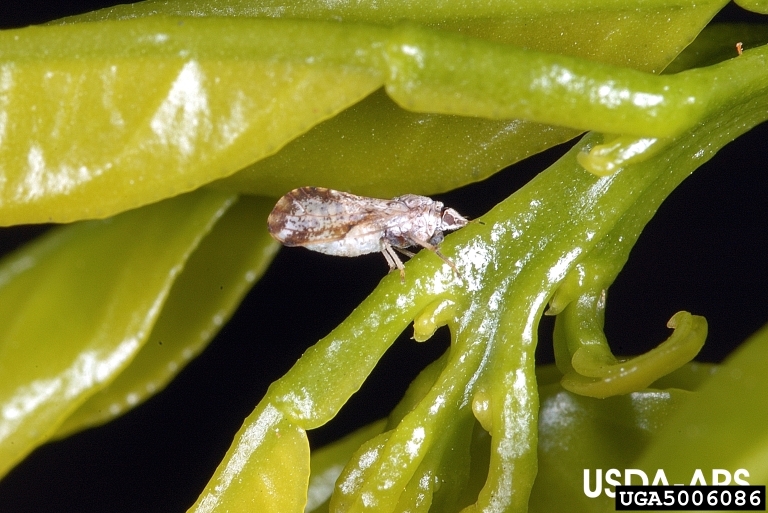
Photo by David Hall, USDA Agricultural Research Service, Bugwood.org
The cotton jassid bug (also known as two-spotted cotton leafhopper) has emerged quickly as a major pest of concern in Georgia. Stormy Sparks, University of Georgia (UGA) cooperative Extension vegetable entomologist, addressed the problem during the conference.
The pest was first found in Georgia in 2025 and has quickly spread throughout most of South Georgia. Cotton is threatened by the pest, but other crops like okra are vulnerable. Certain varieties of eggplant are vulnerable, too. Sparks said that he suspects squash might be vulnerable as well.
“Okra is very sensitive to the jassid,” Sparks said. “You can see a field go green to brown in about two weeks from damage from the pest. Certain plants seem more sensitive to the feeding than others. We think it might be something in the pest’s saliva, but we are not quite sure.”
Sparks said there are several insecticides that are effective in controlling the jassid. But many of the materials are important for whitefly control, which could be problematic if jassid management is required in the spring. This could raise the risk of insecticide resistance with whitefly due to more applications being required throughout the year.
For Georgia citrus growers, vigilance is high for the Asian citrus psyllid (ACP), which transmits huanglongbing (also known as HLB or citrus greening). UGA entomologist Apurba Barman addressed the pest during a presentation at the conference.
“The good thing is, so far, we’ve found ACP in only four counties in commercial groves,” Barman said. “All these counties are coastal or bordering Florida. We know the psyllids are there. The psyllids can establish and they can spread.
“We are putting out a lot of traps. This year, in 16 counties we put out traps with the county agents, and they’re monitoring those commercial groves using sticky cards. Going forward, we’re going to expand to more counties and more fields within a county.”
The monitoring is important to alert growers to initiate spays to keep the ACP in check. The experience growers in Florida have had with the pest and HLB should encourage growers to be proactive.
“The monitoring and sampling for ACP is going to be the key. We just need to keep watching them,” Barman said. “You’re not going to see (just) one … The insect cannot be just by itself. It’s going to have a family, and it’s going to make babies. It will establish populations.
“I think it’s better to be alarmed than be complacent. I would rather be alarmed than do nothing.”
Food Safety
Seminar sessions on food safety were also hosted during the event. The presentations focused on food-safety testing and the quality of data being collected to verify food-safety protocols.
A particular topic of note centered around the question: Can pathogens travel on the wind from livestock operations like poultry and dairy farms? Attention has focused on the matter after there has been some evidence that this could be happening in western states on vegetable farms near large feedlots. This is causing some specialty crop buyers in wholesale and retail to apply that standard to crops grown in the Southeast.
In a presentation by Faith Critzer, UGA professor, and Michelle Danyluk, University of Florida professor, the food safety experts noted that the environmental conditions are very different between the two regions and should be considered.
They presented a research project conducted to see if they could determine if pathogens were moving from poultry farms (in Georgia and Alabama) and dairy farms (in Florida) carried on the wind. They noted that the research project was extremely difficult to design to draw any significant conclusions. More research is needed to try to get more definitive data.
“At the end of the day, we shall see, but we’d really like to give growers some strong data to maybe push back on where they can or can’t plant, based upon what animal operations are around their farm,” said Danyluk.
Video Component
Click here for video component.