









By Clint Thompson
A generational freeze wreaked havoc on Florida’s blueberry crop this past season.
“I have never seen temperatures like we experienced. I had several growers calling my phone and asking what to do. My honest reply was that this is something I dont have any experience with because it is quite an unusual event,” said Gerardo Nunez, assistant professor in the University of Florida Institute of Food and Agricultural Sciences (UF/IFAS) Horticultural Sciences Department.
Nine months removed from Januarys freezing temperatures, Florida’s blueberry farmers and industry leaders are still coping with the aftermath and learning lessons that will help better prepare them for the future.
“I wished I had bought more crop insurance,” farmer Ryan Atwood said. “We should have hedged all the farms right after the freeze instead of trying to turn chicken poop into a chicken salad.”
Variety Diversity
One of those lessons focuses on plant diversity. Growers would benefit from not having all of their crop in one varietal basket, said Phil Harmon, UF/IFAS professor and Extension plant pathologist.
“Having a breadth of varieties that we’re growing at any time that have different maturity dates and timing is important for a lot of reasons, but one of those that reared its head this year was the freeze damage,” Harmon said. “Some of those varieties that are very early, of course, get us into that early market window. There were some that had the most impact from the freeze damage. Keeping a diverse group of varieties that ripen over our window of production is important for us.”
Storm Preparation
Storm preparation is always important for growers. No matter if it is a tropical storm, hurricane, freeze event or drought, producers should prepare as if negative impacts will occur. Proper documentation should be kept, said Doug Phillips, UF/IFAS blueberry Extension coordinator.
“Most growers know this, but if you can see an event like that coming on, whether it’s an extreme freeze or if a hurricane is projected, take a lot of pictures and video before that weather event hits so you can have before and after shots,” Phillips said. “You’ll have good documentation for crop insurance purposes to say, ‘Here’s the actual damage.’That just makes it easier in the process of getting a settlement with crop insurance.”
Protection May Not Be Possible
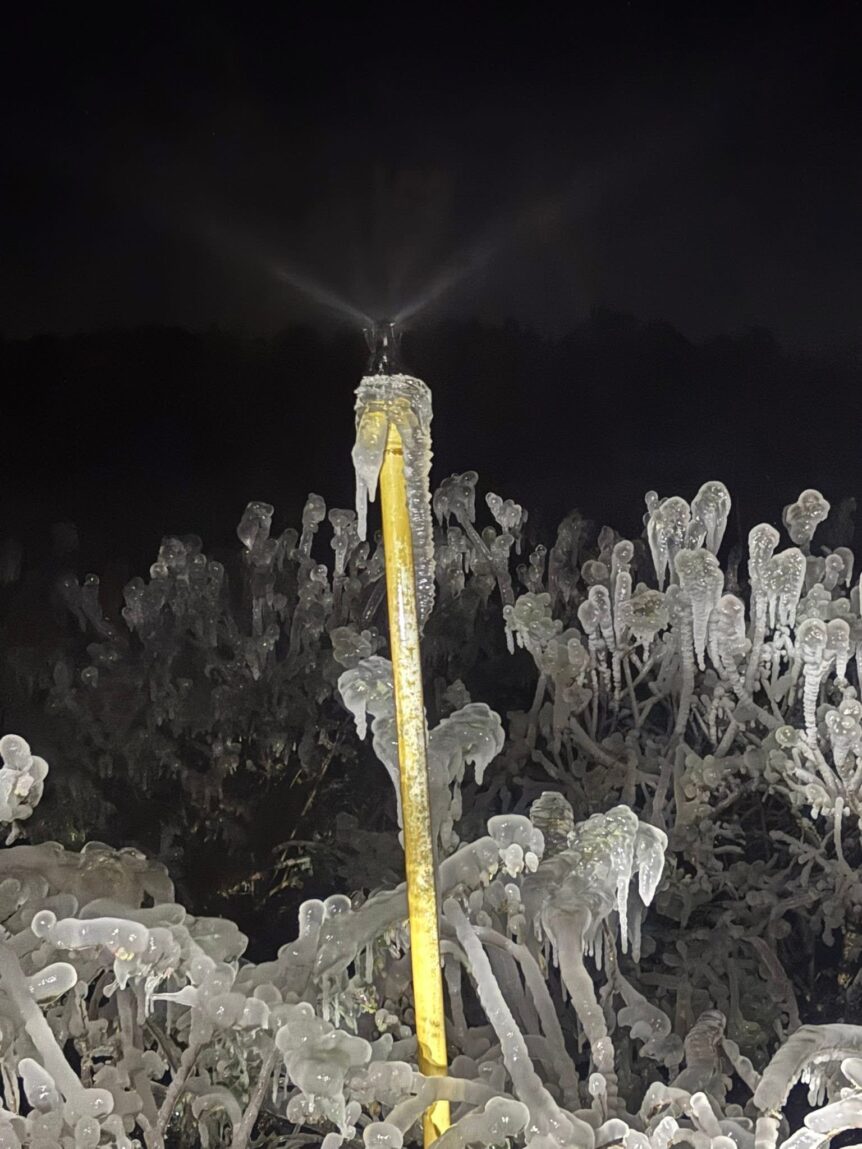
The impulse is for growers to implement freeze protection methods in the event prolonged low temperatures are in the forecast. However, it proved mostly ineffective in this instance, mostly due to high wind speeds.
According to the Florida Blueberry Growers Association, average minimum temperatures across Florida during the freeze ranged from 23 to 30 degrees. The combination of below-freezing temperatures, high winds and dry air pushed many overhead irrigation systems beyond what they could protect.
“Growers that are going to freeze protect use overhead irrigation. If you’ve got heavy wind blowing, it’s just not going to be effective because that wind is going to be blowing that water all around,” Phillips said. “One thing growers took away from the freeze is in that situation where you’ve got heavy winds and extremely cold temperatures, it may not be possible to effectively freeze protect that crop. So, No. 1, it wouldn’t be effective, and No. 2, you could get such a heavy ice buildup that the plants get tipped over with broken canes and limbs.”
Knowledge Gap
The lack of freeze protection effectiveness runs counter to what insurance companies want producers to do.
“Some of the recommendations we made were met with resistance from the insurance industry,” Phillips said.
More information and insight needs to be provided, such as when to run and when not to run irrigation. Phillips said education is needed particularly among the insurance adjusters — the folks who were out doing surveys for crop insurance.
“There is a big knowledge gap that we should be looking at. I hope it will be another 10 or 20 years before we have another freeze event like this one. But it would be naive to think we will be prepared for a future freeze if we dont start acting right away,” Nunez said.