









By Clint Thompson
One of the most devastating watermelon diseases in the Southeast can be overcome. But it comes with a high cost for growers.
Fusarium wilt is an annual problem that North Florida and South Georgia watermelon producers must contend with every year. Some growers are resorting to grafted plants in hopes of overcoming the disease.
Grafting is a production practice where growers put a root system in the ground that either doesn’t get the disease or is highly tolerant. It allows watermelon producers to plant a watermelon crop without fear of the disease impacting production. But growers must understand it is a costly solution.
Josh Freeman, regional sales manager with TriEst Ag Group, estimates the grafted plants, on a per-acre basis, cost twice as much as regular watermelon plants.
What is Wilt?
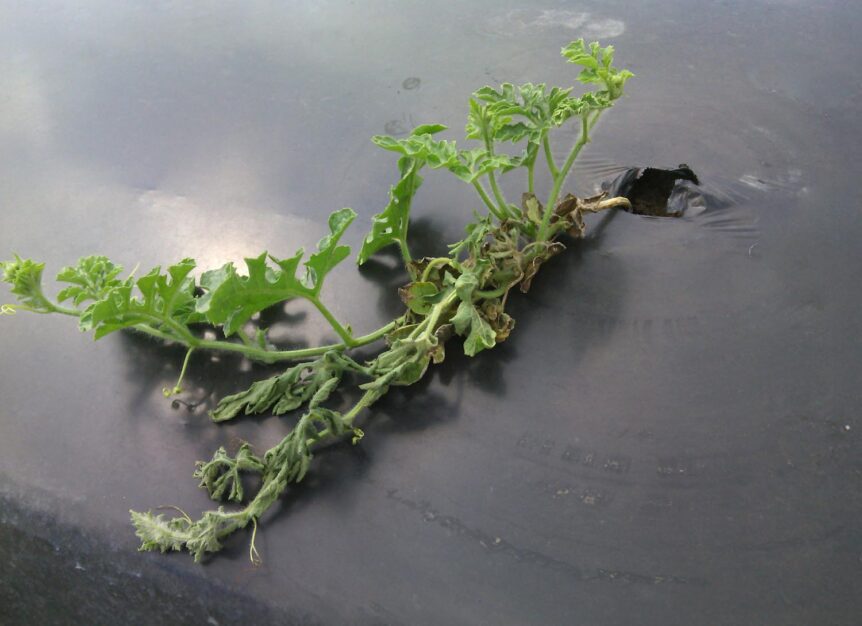
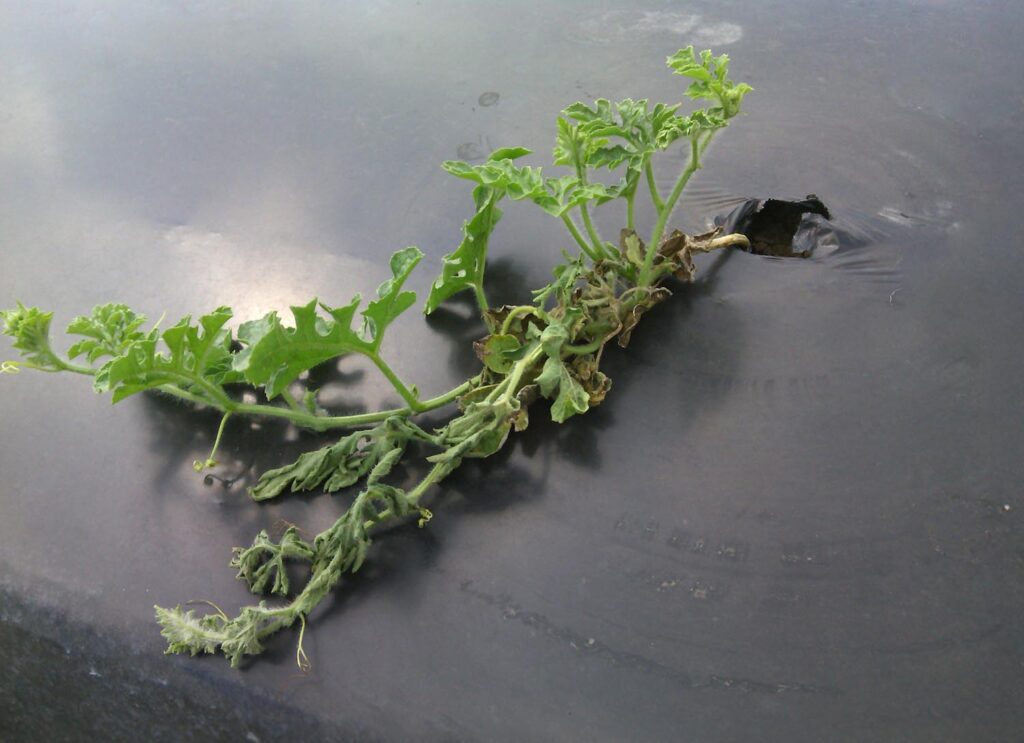
Fusarium wilt is one of the top limiting factors in key watermelon-production areas. The disease’s ability to impact the plant at any stage of growth makes it a significant threat to the crop every year. If symptoms appear at the seedling stage, the plants will not even make it to vines. The plant can produce fruit if the infection is weak, but when the plant begins using the energy necessary to produce fruit, the plant will likely decline and slowly die. Plants infected with the pathogen will eventually die if the infection is severe.
Costly Choices
Growers who are challenged with fields heavily infested with the disease must consider alternatives since fungicides are limited, explains Bob Hochmuth, University of Florida Institute of Food and Agricultural Sciences regional specialized Extension agent in Live Oak, Florida.
“The chemical options are very, very expensive and not effective enough. In terms of what to do, it’s either don’t plant that field or consider grafted watermelons,” Hochmuth said. “In a couple of cases, grafted watermelons were put to the true test on fields that in the past had been devastated by fusarium five or six years ago. The plants performed exceptionally well against fusarium.”
For an industry that strives to cut costs, the added expense of grafting watermelon plants is not an ideal scenario, but it provides farmers with a reliable solution.
“Either you have fusarium and you’re going to grow grafted plants, or you have fusarium and you’re not going to grow watermelons,” said Freeman. “It’s unfortunate that this is the only real tried-and-true solution. It’s unfortunate in the fact that it’s a costly control measure. But if a grower has limited access to land and they know they have fusarium, you’re either going to roll the dice and maybe you get 20% of your yield, or you’re going to plant grafted plants, and you know you’re going to pick watermelons.”
An area in Florida between Levy and Gilchrist counties is heavily concentrated with fusarium wilt disease. Land rotation is not considered an alternative since land availability is minimal. Rotation recommendations are for five to seven years between watermelon plantings in the same field.
Later Maturity
Growers pondering the use of grafted plants also must consider the later maturity date of the plants. According to Freeman, there is a five- to 10-day maturity gap between the standard plants and grafted plants if the scions are the same.
“The scientific community doesn’t know why,” Freeman said. “Maybe it’s got something to do with the grafted process itself — healing and hormone balance in the plants. Nobody knows. On average, they tend to be a touch later. We’re trying to minimize it, because it’s a problem, especially for this area.”
A later maturity date is not ideal for watermelon growers who only have about a three-week period to harvest and market their crop every year.