









By Shinsuke Agehara
University of Florida Institute of Food and Agricultural Sciences (UF/IFAS) research shows that intermittent sprinkler irrigation has great potential to establish Florida strawberries more efficiently — saving water while potentially boosting yield.
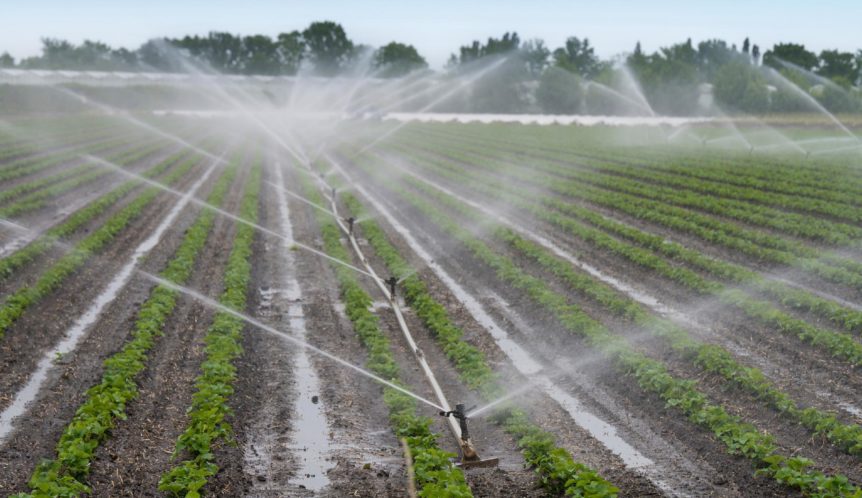
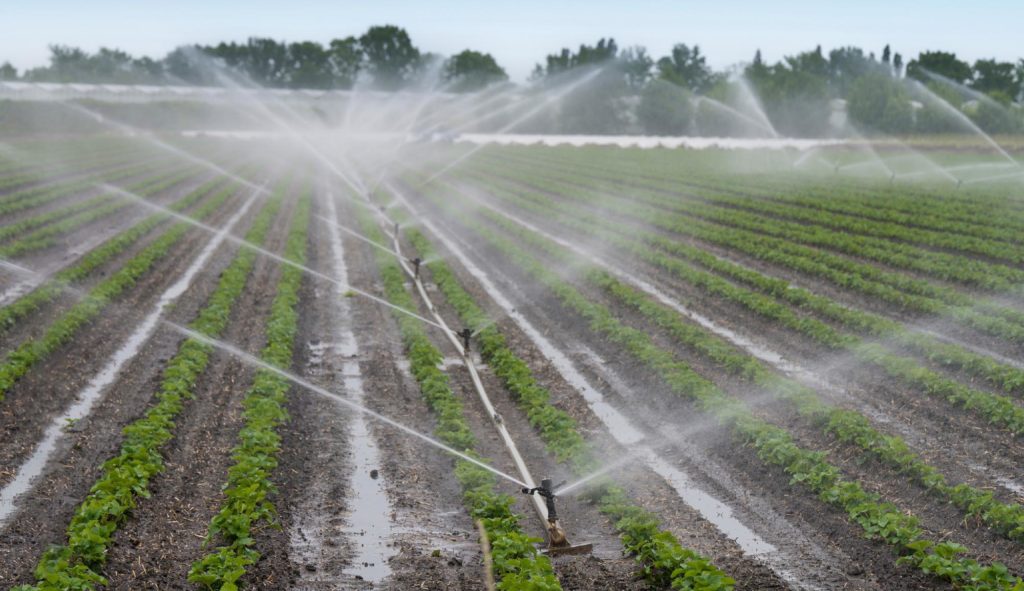
Most Florida strawberries are established from “bare-root” transplants. They are dug out of nursery fields, often in northern California or Canada, and shipped to Florida farms in refrigerated trucks. Because their roots are exposed and damaged, transplants are extremely vulnerable to drying out in the field, especially under Florida’s high temperatures. That’s why young plants need sprinkler irrigation to stay hydrated — typically eight to 10 hours a day during the first two weeks after transplanting. This establishment period alone can consume about 400,000 gallons of water per acre.
A research team at the UF/IFAS Gulf Coast Research and Education Center (GCREC) explored ways to use water more efficiently without scarifying yield.
Intermittent Irrigation Research
Researchers tested a technique called intermittent irrigation. Instead of running water continuously, sprinklers cycle on and off at regular intervals. While this technique can easily save water, it surely increases heat and dehydration stress in newly transplanted plants. The key questions were: 1) How would it affect plant establishment and yield? and 2) What level of stress is acceptable?
Supported by the Florida Department of Agriculture and Consumer Services, field trials were conducted at GCREC during the 2021−22 and 2022−23 seasons to compare continuous sprinkler irrigation with three intermittent programs, including 10/10, 10/15 and 10/20 minute on/off cycles. Bed wetness, bed surface and leaf temperatures, and the leaf desiccation rate were measured during the establishment period. Canopy growth, yield and fruit quality were recorded throughout the rest of the season.
Unexpected Results
The results were both surprising and exciting. Plants under intermittent irrigation showed more stress symptoms, including higher leaf temperatures and faster leaf desiccation, but they established new canopy just as well as or even faster than plants under continuous irrigation.
A major strawberry cultivar, Florida Brilliance, actually produced up to 27% higher yield with intermittent irrigation in one season. These results challenged researchers’ expectations. They thought they might save water at the cost of yield, but instead, the opposite was seen.
It is believed that short drying cycles gently stress the plants in a beneficial way. After transplanting, plants must shift their resources to grow new roots. The brief drying cycles accelerate leaf desiccation, promoting the movement of carbohydrates and nutrients from leaves to roots and stimulating faster root development. Once sufficient roots are developed, plants can redirect their resources to canopy growth and fruit production.
What it Means for Growers
The research shows that the 10/10 minute on/off cycle can be safely implemented for Florida cultivars, enabling 50% savings in sprinkler irrigation, or about 200,000 gallons of water per acre. If this practice was adopted widely across Florida’s strawberry industry, which covered 16,200 acres in 2024, it could save billions of gallons of water annually. Beyond water conservation, growers could reduce energy costs and nutrient leaching risks while maintaining or even increasing yield.
The next step is to test this system on commercial farms to confirm that the benefits hold under real-world conditions. If they do, UF/IFAS will collaborate with growers and irrigation specialists to help transition to this more sustainable irrigation method.
Shinsuke Agehara is an associate professor at the UF/IFAS GCREC in Wimauma.