









The Georgia citrus industry now has a better grasp on the extent of damage to the state’s crop following the recent freeze events in February and January. Dieback is present in both younger and older trees, says Mary Sutton, University of Georgia (UGA) assistant professor and citrus Extension specialist.
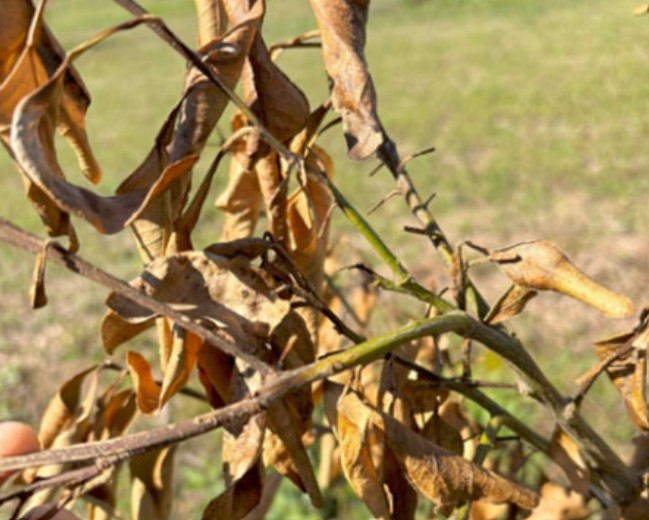
Photo courtesy of UGA
“For most of the older, established trees that have gotten some pretty good size on them, it’s still just minimal damage. There is some leaf drop and maybe a little leaf burn,” Sutton said. “Some of the green wood that’s on the very edges of the canopy has dieback, but for the most part, the core of the tree is still good.
“The younger trees definitely took a harder hit. We’re seeing a lot more dieback and a lot more leaf drop. We’re still seeing that dieback happening. So we’re not quite sure yet how bad it is, but I’m hoping it didn’t completely kill the trees.”
Citrus dieback is usually associated with citrus greening disease and can lead to tree decline and death.
“With the dieback, it’s mostly on the green wood. Usually it will start at the very tip of the branch where cells were damaged by the cold weather,” Sutton explained. “It will slowly spread down the branch. The cells that were damaged eventually do die, and we’ll see that dieback move backwards down the tree. Green wood tends to be the more susceptible wood, so that is where we tend to see dieback, but it can happen in older, more mature wood.
“Now is when we’ll start to get an idea how bad the dieback is. Then, in a couple of weeks is when we should start seeing the spring flush. That will give us a really good idea if we’ll be able to fully recover the canopy that was lost.”
Now is also the time for pruning practices to commence, which should help revive the trees.
“It’ll definitely help. It’ll get rid of all the dead wood,” Sutton said. “When you’re cutting into living wood, you have to make sure you’re cutting into wood that’s still green. When you cut back into living wood, it can help trigger a flush. So you should start seeing the canopy growth. If you leave that dead limb on there, it’s not going to be productive.”

By Clint Thompson