









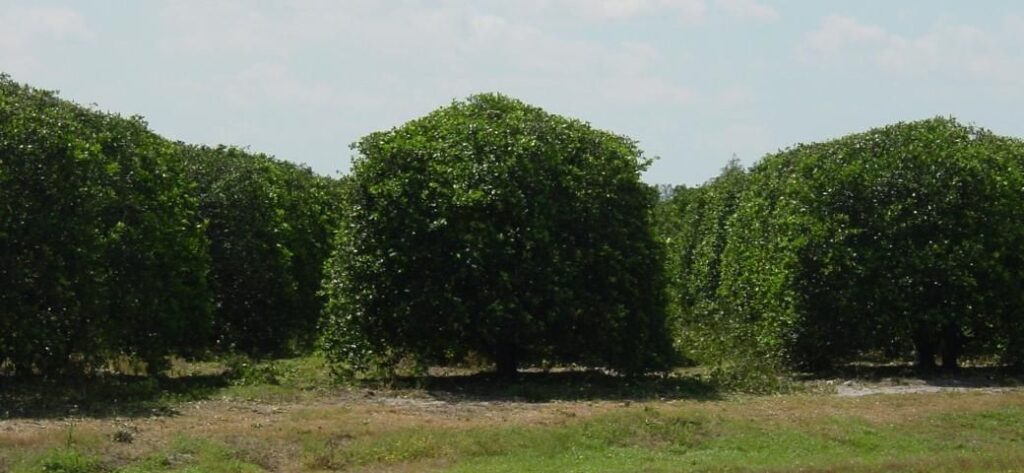
Photo by Mongi Zekri, University of Florida Institute of Food and Agricultural Sciences
One of satsuma mandarin’s drawbacks is its alternate bearing tendency. It will produce a heavy crop load one year and a low one the next year.
Mary Sutton, University of Georgia (UGA) assistant professor and citrus Extension specialist, said tree hedging may provide a solution. She discussed the management technique at the Southeast Georgia Citrus Update in Lyons, Georgia on July 28.
“One of the things we’ve seen with satsuma is it does look like it has fallen into this heavy alternate bearing pattern. We’re looking at hedging as a way of thinning out the crop load during the spring in these potentially heavy years,” Sutton said. “The hope is that by reducing the crop load in the heavy year, in the subsequent year we’ll see a more even crop load instead of having the high-low years.
“Usually with citrus, you will see a natural on and off year, but it’s not as extreme as we’ve seen with satsumas, where we have a ton of fruit one year and no fruit the next. We’re just trying to get back to a place where it’s a bit more even year to year.”
Hedging is a type of pruning where a specialized piece of equipment will travel through the grove and cut off the sides and the tops of the trees. The result is trees with a square hedge shape. Producers can do the process themselves and cut out specific branches and shape the tree how they like.
Hedging will also help growers maintain tree size to where it needs to be.
“With some of our full-size citrus, you could get a tree 20 to 30 feet tall. That’s much harder to harvest. Hedging can be used to maintain the size of your tree and make sure your equipment can still get up and down the rows,” Sutton said. “That’s already part of a general maintenance plan. We’re seeing if it has an added benefit for the alternate bearing and if it’s something that needs to be a yearly or rotational practice. We’re trying to figure all that out.”

By Clint Thompson