









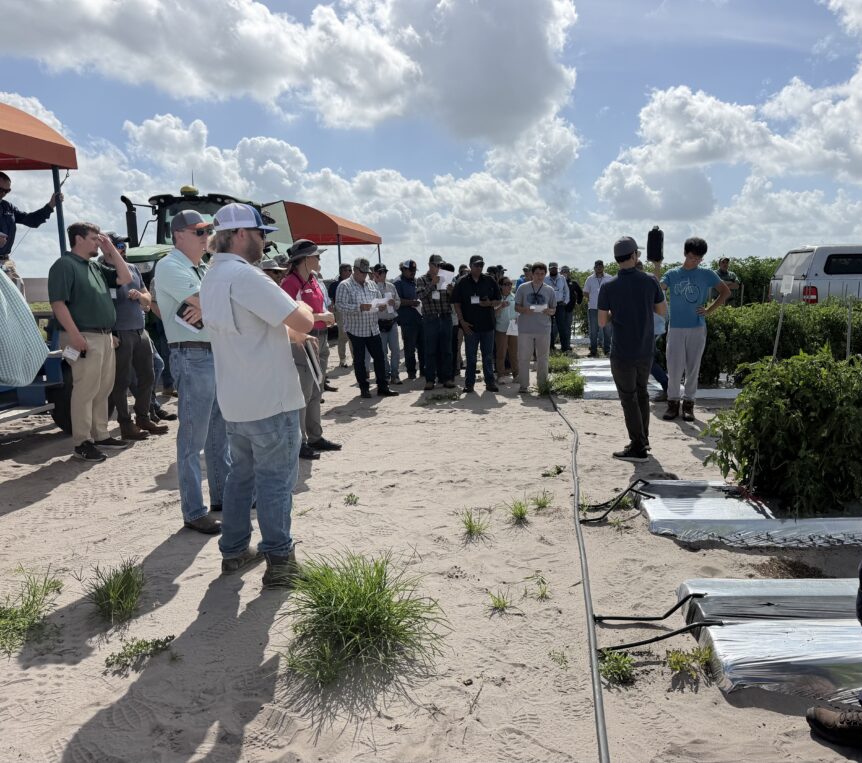
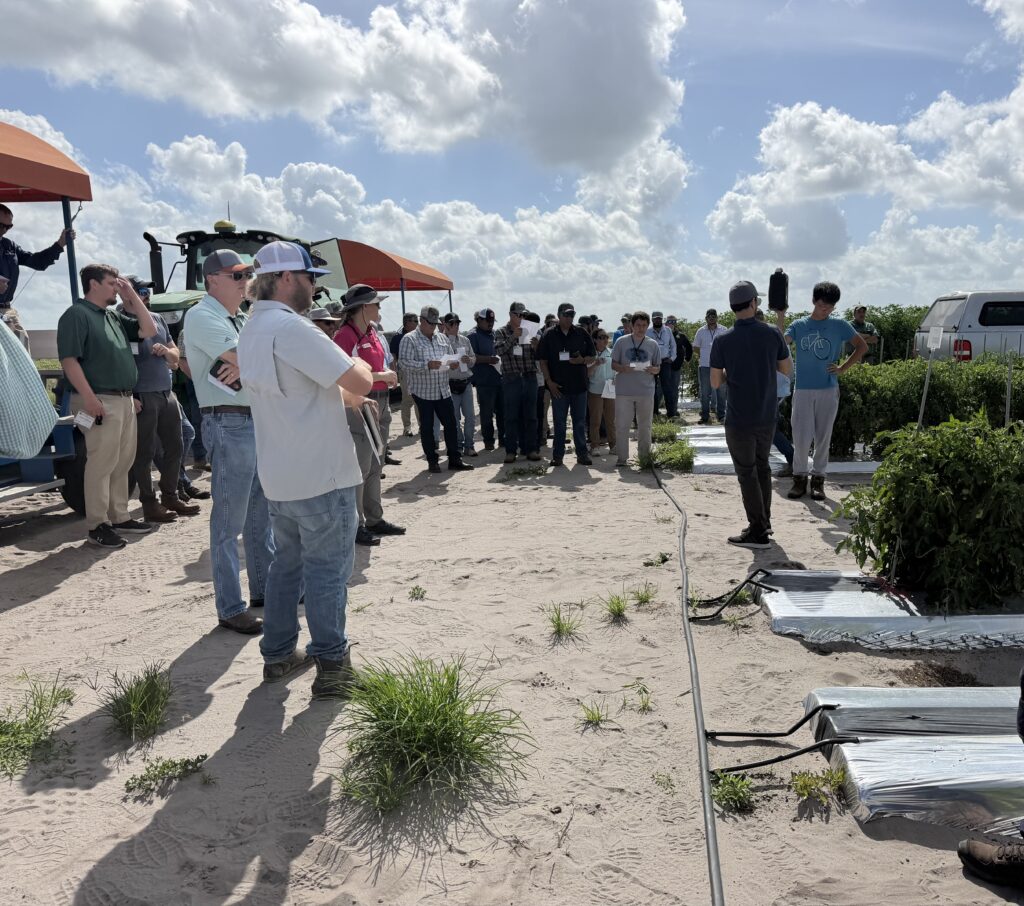
In late May, the University of Florida Institute of Food and Agricultural Sciences (UF/IFAS) Gulf Coast Research and Education Center in Wimauma hosted its annual tomato field day. Attendees were able to see new varieties that are in development and attend seminar presentations after the field tour concluded.
Jessica Chitwood-Brown, UF/IFAS assistant professor of horticulture and tomato breeding, guided tours of tomato plots where new varieties are being evaluated. One variety she is particularly excited about is a hybrid that has shown good resistance to bacterial spot, which can be a major problem for growers. This resistance was arrived at by editing the Bs5 gene using CRISPR technology.
Chitwood-Brown said the variety performed well in trials across the state and was the best performer in a trial in LaBelle. She noted the crop was harvested before the freeze struck in late January and early February. While none of the varieties have been officially released, she said there is a lot of interest in them due to the problems bacterial spot can cause in tomatoes.
Another variety type growers are interested in is stakeless tomatoes, which would have the ability to be machine harvested. Given the difficulty of sourcing labor and its high cost, growers are looking for alternatives like machine harvest.
Continuing on the theme of bacterial spot, Gary Vallad, UF/IFAS professor of plant pathology, showed attendees his ongoing work to evaluate the movement of the disease’s spores through the air. He and his team have created 3D-printed vacuums that suck up the air in and around a tomato plot to see how far disease spores can move.
Vallad noted that most chemical sprayers are applying materials under 250 to 300 psi. This much pressure could be spreading bacterial spot to other places in the field. The research has shown that sprayers will move spores. In the future, the research might lead to recommendations on how to lower the potential of spore spread when spraying fields.

By Frank Giles